
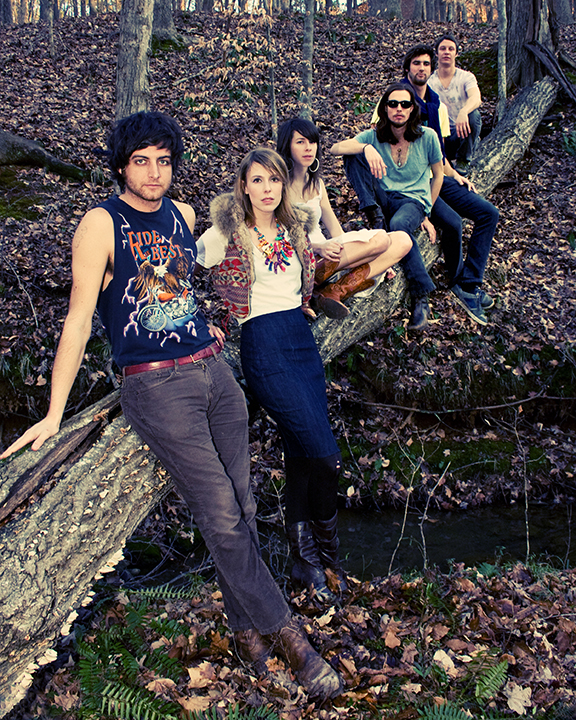
Stu McLamb is nostalgic for his first album as The Love Language, released a decade ago this summer. “It was such a time and place and excitement,” he says. “You don’t get that chance again. Turning on this little tape recorder and hearing sound back, it was the first time I’d recorded stuff on a bigger scale.”
It helps that there’s so much scrappy, sprawling mythology scaffolded around the self-titled album and the band that made it. Eleven years ago, McLamb was living with his parents in Cary, following the splintering of both a band and a relationship; an opportunity to play with The Rosebuds spurred him to form his own new band with Josh Pope on bass, Kate Thompson and Missy Thang on keyboards, Jeff Chapple on guitar, Tom Simpson on drums, and percussionist and guitarist Jordan McLamb. They recorded the album in 2009 and fractured shortly after. Now, a decade later, the original members (except Pope) are playing a July 12 reunion show at Cat’s Cradle. Merge Records is also reissuing the debut, which has been out of print for years.
David Menconi’s 2009 SPIN review of the self-titled LP phrased the band’s beginnings efficiently (“Heartbroken North Carolina boy fashions lo-fi indie stunner at Mom and Dad’s”), although that narrative bears a second glance, as most mythologies do. McLamb still scans as boyish, but he was in his late-twenties by the release of the record, with a tangled band history already behind him (most notably with the Capulets) before he began his feature project.
Still, there was something about these songs and the band that coalesced around them that felt fresh and just worked. There was a moment when The Love Language seemed like the torch-bearers of the local indie-rock scene, flanked by The Light Pines, Ryan Gustafson, Max Indian, and other bands that sparked propulsive energy, or what McLamb describes as “a good kind of competitiveness.”
The distorted, lo-fire register of The Love Language had genuine origins—recording sessions pinballed between basements and storage units around North Carolina—and, married with dreamy, infectious hooks, that sensibility makes for the feeling of a messy summer, of wine-rings on a picnic table and stubbed-out cigarettes in a Citronella candle. It’s a breakup album, if not exactly a heartbreak album, and the distinction feels important: Rather than honing in on regret or longing, frustration chafes against some amorphous, energetic thing—mania or joy, maybe, depending on whom you ask.
“Something that was cool about when we came around was that people were figuring stuff out and using less advanced technology to do that. I think there’s a charm to that,” McLamb says. “That was something that helped make the music what it was from not being able to overthink it. Mess-ups add a lot of humanity.”
The band toured nationally before McLamb signed with Merge Records at the tail end of 2009, and things began to sour between the band.
“I think it’s a pretty open secret that it wasn’t the most amicable split,” Thompson says, “There were a lot of feelings of, ‘I thought we were all in this together,’ and then maybe it became clear that it was really Stu’s project and we all wanted a little more ownership over it. I think our personal lives started to get a little more complicated and we were all living in a house together. And just a bunch of dudes. It was magical and I appreciate it for what it was. But it was also really stressful.”
After making 2010’s Libraries and 2013’s Ruby Red with a rotating cast of new band members, McLamb moved to LA, opting for a fresh start; last year, he put out fourth album Baby Grand, which Simpson also plays on. The rest of the band, meanwhile, lost touch. Thompson had stopped playing music altogether and moved to teach abroad for a stint before returning to head up Body Games. And then, last year, after nearly a decade of not speaking, a run-in at Hopscotch between Thompson and McLamb—aided by a handful of fireball shots at Slim’s—prompted talk about getting the band back together for a reunion show. Fortuitously, this conversation came just ahead of the ten-year anniversary of the first album.
“Time heals,” Thompson says. “We were practicing in this little rehearsal space behind a Cup A Joe, and—you know that feeling when you’re watching your favorite Disney movie and you’re washed over with this very youthful, juvenile excitement and warmth? It feels like a reset, like coming home when you thought you could never come home again. I can’t speak for everyone, but it feels bigger and more emotionally healing than what it appears to be. The scabs are there, the scar tissue is there, but it’s fine.”
As an album, The Love Language rewards revisitation. Opening track “Two Rabbits,” is a warbly cinematic ballad that begins with whimsy before sweeping into a rejoinder about mistakes and wanting to die in somebody’s arms. It has all the offbeat poeticism of a Joanna Newsom song, if somewhat lacking the depth of a Newsom lyric, but courses with so much obsessive emotion and voice-cracking confidence that you’d be forgiven for forgetting to peel away the first layer in search of the next. “Lalita,” which immediately follows, is also about mistakes, although in this one, any regret has given way to a rollicking, aggrieved energy.
“The Love Language is very earnest,” Thompson says. “But it’s earnest about somebody else’s feelings. I feel strongly about it because it’s relatable and those songs mean a lot to me now. I was giving a performance. It was a truly felt thing. It was sincere but it wasn’t mine. But man, I loved those songs. Listening to them again, I don’t think I really fully appreciated how fucking good they were.”
By the last song, the band’s animation has placed you in the middle of an emotional capsule so full of highs and lows and wobbling uncertainties that you feel as if the key thread of some original argument has been body-surfed away in the crowd and lost altogether.
The final quartet on that last song, “GrayCourt,” closes with a clincher that, in the rear-view mirror of a decade, looms larger than maybe intended: “Love is built like a diamond / But breaks just like glass / You were the first / And you’ll be the last.”
Support independent journalism. Join the INDY Press Club to help us keep fearless watchdog reporting and essential arts and culture coverage viable in the Triangle.

You must be logged in to post a comment.