

This story first published online at North Carolina Health News.

Early in the morning on July 28, 2017, Amber DelVechio’s phone rang. She missed the call, but it woke her up. She rolled out of bed and began getting ready for her job as an executive assistant at a manufacturing company in Newton, in Catawba County.
Her phone buzzed again. It was the same number: “Are you Madison’s mom?”
DelVechio typed back, “Yes. Why?”
Call me back, the stranger responded.
DelVechio, who has long blonde hair and a soft voice, had grown somewhat accustomed to these sorts of pre-dawn calls. Her 18-year-old daughter, Madison Workman, injured her ankle four years earlier and a doctor prescribed the teenager an opiate-containing painkiller. She’d struggled with substance use disorder since.
When Workman was actively using drugs, she’d call her mom at odd hours. DelVechio tried to always answer, and she tried to treat the situation with softness when she could. At some point, the mother began to think about the 3 a.m. conversations—and her newly disrupted sleep schedule—as if she had a newborn again. In that scenario, she wouldn’t get angry for having been woken up. She’d roll out of bed, pick up her baby, and pat her on the back. She’d bring warmth and comfort. She’d hope that one day soon they’d both be able to sleep through the night.
DelVechio wrote back, “I’m getting up, I’m getting ready for work. Can I call you on my way to work?”
The stranger responded, “No. Sorry. Emergency.”
At that moment, the mother felt something shift. She picked up her phone and called the number. On the other end, a sobbing woman quickly answered, saying, “Somebody left your baby on my porch.”
A nationwide problem, worse in North Carolina
Since Workman died in 2017, more than 10,000 other North Carolinians have also died from drug overdoses, according to state data. Recent numbers from the Centers for Disease Control and Prevention show that over the last year, the crisis grew even worse. More than 100,000 people across the country died of overdoses between April 2020 and April 2021. Over that period, the nationwide overdose death rate rose 27 percent.
In North Carolina, it grew by 37 percent.
While the numbers are staggering, physicians who specialize in addiction medicine, researchers who study drug use and policy, and harm reduction outreach workers say the rise is disturbing, but not surprising. It’s likely the result of many factors, some of which have existed for a long time, overlaid by the nearly two-year-long pandemic.
First and foremost, experts say, the proliferation of fentanyl is to blame.
“Fentanyl has poisoned our entire illicit drug supply. There is nothing on the street these days that doesn’t have fentanyl in it,” said Michelle Mathis, the executive director and co-founder of Olive Branch Ministry, a faith-based harm reduction organization that serves 10 counties in the Piedmont foothills.
“We know that it’s not only in the opioids, but it’s also in the stimulants,” she said.
Becca Goldstein, a Haywood County outreach worker with the North Carolina Harm Reduction Coalition, said the presence of fentanyl in stimulants is especially perilous because people don’t expect it.
People who knowingly use opioids can be prepared for a potential overdose by keeping tools such as naloxone, an opioid overdose reversal drug, nearby. Someone who uses methamphetamine may be less likely to have that around.

“Fentanyl has more or less taken over,” said Jana Burson, an addiction medicine physician in North Wilkesboro. “It used to be very hard to find heroin, let alone fentanyl, out in the rural areas. But now, that’s about all I see. It elevates the risk because it’s so much more powerful.”
To help manage that risk, Olive Branch and other harm reduction organizations distribute fentanyl test strips.
Last year, Mathis said, the agency gave out 29,000 test strips, which cost about $1 each. Harm reduction advocates encourage everyone who uses drugs to test their supply beforehand. They argue that when people know what’s in their drugs, they can make better-informed choices: Am I going to “microdose”? Use with someone? Or skip this batch and try to get a new one?
A pandemic, plus mental health crises, plus poor overall health, plus lack of funding
While fentanyl might be the single greatest source of rising deaths, really understanding the issue requires a multi-pronged approach.
“The first thing is with COVID-19,” Mathis said. “What we’ve seen is an increase in isolation, an increase in anxiety, an increase in brain health challenges. And so that sometimes promotes the use, or leads to increased use, in substances — licit or illicit.”
Burson explained that all drug use, including alcohol consumption, increased during the pandemic.
“We see more adverse effects from alcohol, just like all the rest of the drugs.”
Overdose deaths are proving to be just one of many signifiers of rising distress as we approach the second anniversary of COVID.
“We know that the pandemic was good for nobody’s mental health, right?” said Elyse Powell, the state opioid coordinator with the state’s Department of Health and Human Services. “It’s not just overdoses that we saw increase—we saw increases in suicides and suicide attempts, overall reports of depression and anxiety.”
Perhaps also to blame for worsening outcomes, those in the field say, are cuts to state funding for mental health services. Partners Health Management, for example, provides mental health and substance use care to people in 14 counties in the western and Piedmont regions. The local management entity/managed care organization, or LME/MCO, has seen its state allocation cut by $60 million over the last six years.
“The cuts have resulted in the need to limit provider contracts for state-funded services and has curbed our ability to reinvest in many critical community programs and projects, including those to support individuals with substance use disorder,” Rachel Porter, the chief administrative officer at the agency, said in a statement.
Mathis explained that the funding cuts to Partners deeply impacted Olive Branch. The agency no longer receives enough funding to operate its post-overdose response teams, called PORTS, in Lincoln, Gaston, and Cleveland counties.
When these teams did exist, staff members were on-call 24/7. They’d meet with people soon after they overdosed and offer them access to safer-use supplies, such as fentanyl test strips and naloxone, or, if requested, provide referrals to rehab and detox facilities.
“We would follow up with that individual daily for a week, then every other day for another week, and then once a week, for up to three months, to help make referrals for that person and make sure they’re okay,” Mathis explained. The organization will still provide safer-use supplies at distribution sites, but without funding, they can’t expect staff to be on-call every day.
‘A vicious cycle’
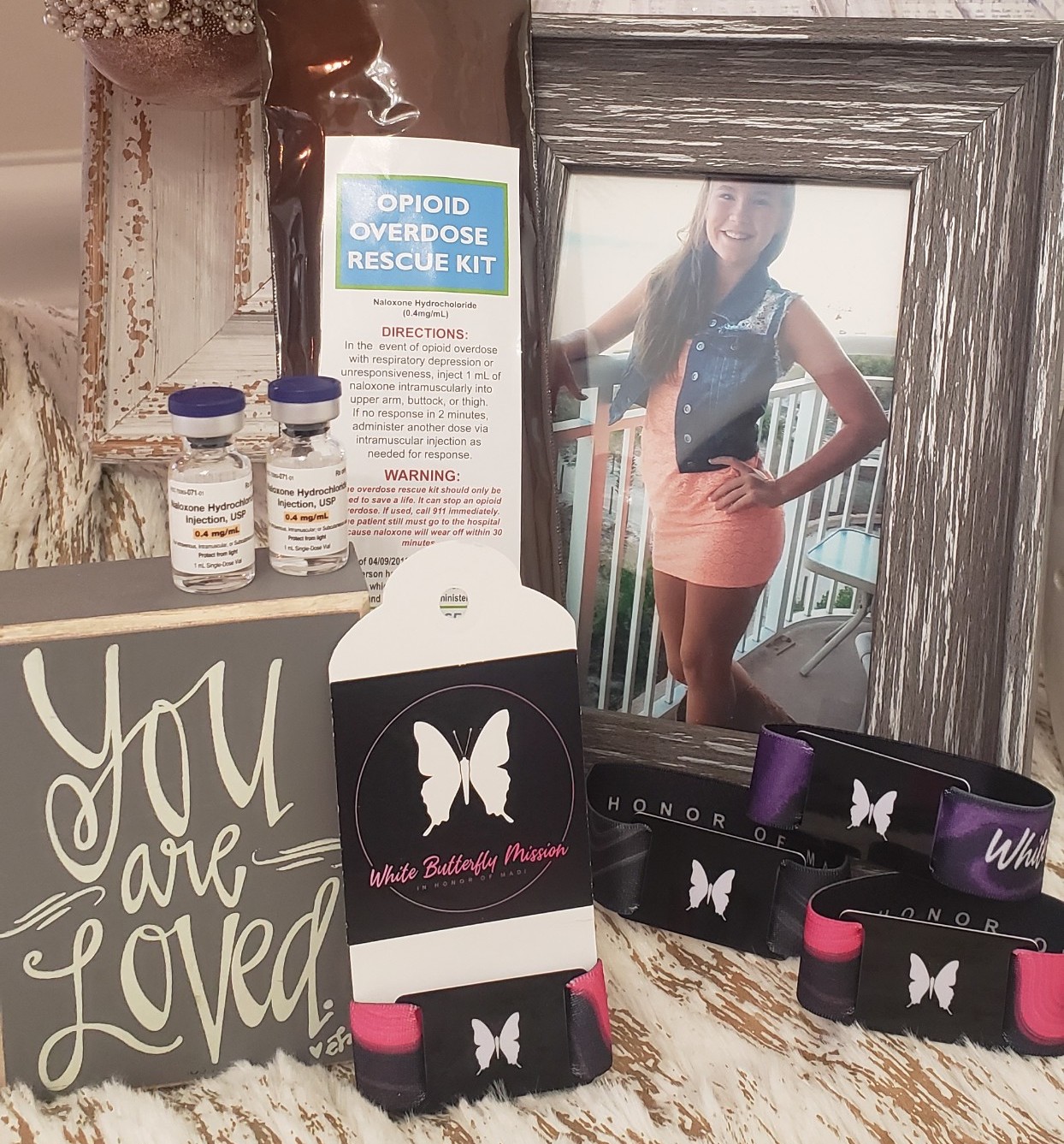
Before Madi—as her mom called her—died, she went to rehab. As she left the facility, she told her mom her career goals had changed. For most of her life, she had wanted to be in the Air Force. Now, she wanted to do something to help people experiencing substance use disorder. To start, she made a long post about her experience on Facebook.
She also began sitting and speaking with people in public places—“at Walmart,” DelVechio remembered, “on the side of the road”—who looked like they might need help.
“Her main thing was just, she said, ‘Mom, I have to talk to people, I have to tell people about this and to make them understand that they don’t have to do this,’” her mom remembered. Workman’s goal, though, was not to shame people into not using drugs or try to force them to quit. She just wanted people to know they had someone to talk to, someone who’d been there and understood.
“She just wanted to be empathetic to other people that were going through it. That was her main thing,” DelVechio said. “She never met a stranger.”
Because Workman didn’t get to do the work she wanted for very long, DelVechio carries on in her daughter’s honor. On Nov. 21, which would have been Workman’s 23rd birthday, her mother launched an organization called White Butterfly Mission. They sell partially recycled white butterfly bracelets. For each one bought, they buy and donate an overdose reversal kit.
She also works for a company that’s studying the use of fentanyl test strips.
“I do the interviews for people that are in active IV drug use,” DelVechio said. The goal is to learn from the expertise of IV drug users about what sorts of programs and services work for them.
DelVechio came into this role after a referral from Mathis, the executive director of Olive Branch.
“Michelle actually contacted me,” DelVechio said, “because she needed someone without judgment, without stigma, that could interview people in active substance use, and she knew that I would be able to do that because I lost my daughter.”
Hard lessons
After more than four years without her daughter, and as much time spent learning and working in harm reduction, there are many things DelVechio wishes she would’ve done differently. She often took a “tough love” approach with her daughter. She didn’t know many of the evidence-based approaches to helping someone experiencing addiction that she knows now.
“Sometimes just giving somebody a box of syringes that have not been used is part of harm reduction, that is part of safe use,” she said. “You’re giving them naloxone kits, you’re giving them Narcan, you’re helping them to basically stay alive so they can have another opportunity to possibly one day get into long-term recovery. Unfortunately, and tragically, Madison didn’t get that chance.”
Workman died of a fentanyl overdose. A toxicology report showed she had just 9.6 nanograms of cyclopropyl fentanyl in her system, the size of a grain or two of salt.
Two years after her death, a 23-year-old pled guilty to second-degree murder for supplying Workman with the drugs. He was sentenced to 10 to 13 years in prison.
When DelVechio thinks about him, it just makes her sad. She said he was also experiencing substance use disorder, that he was an excellent high school football player, that he also had his whole life ahead of him.
“I hate this disease,” she said through tears. “I hate it. It’s just very tragic all around. Now he’s in prison for 10 to 13 years. He has a little girl. It’s tragic for their families as well. And the trauma that that little girl’s probably going to have because her daddy’s in prison and everything—you know it’s just a cycle, a vicious cycle.”
Support independent local journalism. Join the INDY Press Club to help us keep fearless watchdog reporting and essential arts and culture coverage viable in the Triangle.
Comment on this story at [email protected].

You must be logged in to post a comment.