
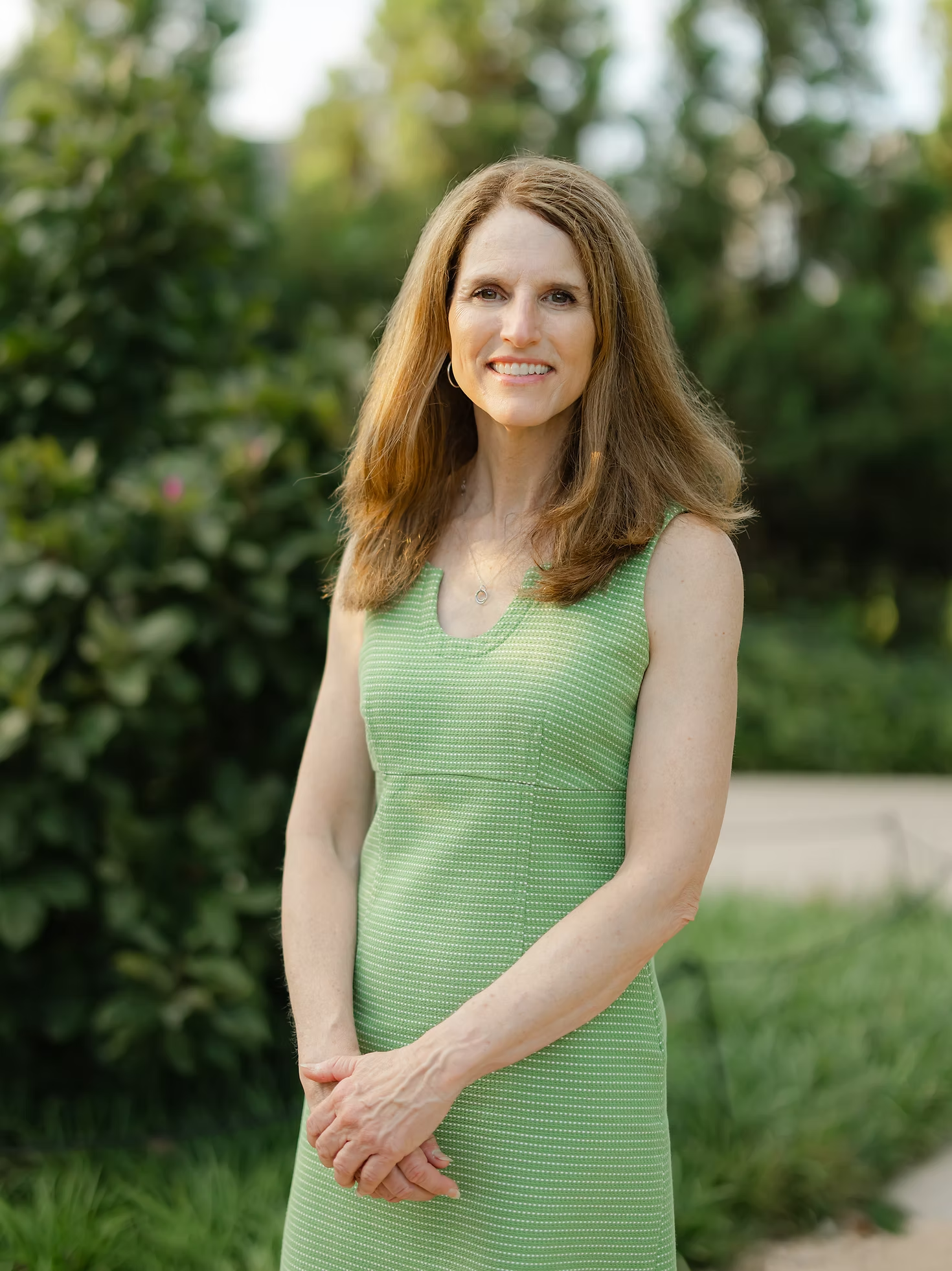
Full name: Jennifer Robinson
Party affiliation: Republican
Campaign website: jenniferforcary.com
1) In 300 words or less, please give our readers your elevator pitch: Why are you running? Why should voters entrust you with this position? What prior experience will make you an effective member of Cary’s town council?
I began serving on the Cary Town Council in 1999 to help guide our town’s growth thoughtfully, preserve the character that makes Cary special, and ensure we continue moving in the right direction.
Throughout my time on the Council, I’ve never lost sight of the values that got us here: forward-thinking planning, smart investment, and a commitment to high-quality services and infrastructure. I’ve worked to build on the successes of past leaders and uphold their standards of excellence. I am running again because I believe deeply in the need for strong, experienced leadership to help our town navigate the complex land use and fiscal challenges ahead.
Over the past 26 years, I’ve delivered tangible results for Cary. Whether through Council work, nonprofit involvement, or service on quasi-governmental boards, I’ve helped turn ambitious goals into lasting achievements that benefit Cary residents. My track record reflects not just dedication, but the ability to get things done.
I’ve spearheaded or been instrumental in initiatives that have shaped Cary, including:
• The addition of 30 parks; 97 miles of greenways; 2,365 acres of public open space; and 5,311 acres of private open space
• The building of West Regional Library
• Road improvements like Davis Drive, Highway 55, and the intersection of Cary Parkway and High House
• Creation of the Economic Development Commission
• Tree Preservation Task Force which was pivotal in advancing our standards for tree protection and planting
• Stormwater initiatives that protect people and properties from flooding
• Programs like Oasis and Healthy Homes for residents in need
• Numerous policies promoting safety, mobility, and environmental stewardship
• and so much more which is woven into our community today.
I have been a committed advocate for residents, and I have the experience, knowledge, and relationships to continue to lead Cary well.
2) What would your priorities be as a member of the town council? Please identify three of the most pressing issues Cary currently faces and how you believe the town should address them.
Our challenges are evolving, and new tactics must be taken to keep Cary a community that people love. With less than 10% of our land left for development and rising costs across the board, it’s more important than ever that we are deliberate in how we tailor our growth and manage our finances. If re-elected, I will help guide Cary through our land use and fiscal challenges—ensuring we remain one of the best places to live and work. To do this, we must be careful about how we spend our money. This is a time for us to focus on the fundamentals.
My priorities will be to:
• Keep Cary residents safe
I’ll continue investing in our core services that matter most to residents: safe roads, reliable water and sewer systems, trusted police, and responsive fire protection.
• Uphold our high standards
I’ll invest in maintaining our infrastructure, amenities, services, and green spaces before spending on new projects.
• Keep taxes as low as possible
I will encourage my fellow council members to revisit, reaffirm, and uphold the fiscal policies and practices that past Councils adopted.
3) What’s the best or most important thing the Cary town council has done in the past year? Additionally, name a decision you believe the town should have handled differently. Please explain your answers.
The most important thing the Cary Town Council did this year was to choose to pause capital projects in light of the fiscal challenges we are facing. The Council reviewed all of our capital projects and selected 68 projects totaling approximately $83 million to pause. Some projects were fairly easy to put on hold, but others were very difficult choices. For example, residents in my district have been waiting for years to have a sidewalk added to Louis Stephens Drive. That project will not be going to construction during this year, as previously planned.
The severity of our financial situation was exacerbated by the 2023 decision by the Council to draw our General Fund balance down. Because the fund balance was low, we did not have the funds to address the higher than expected inflation and lower than expected sales tax revenue. Further, we put the town at risk of losing its AAA bond rating. We hope this year’s budget will get us back to having an appropriate fund balance.
4) President Trump is working to ramp up deportations and curtail visas. At the same time, the state legislature has passed laws requiring agencies to cooperate with ICE. What do you think the town council can or should do to ensure safe, welcoming communities for immigrants in light of these policies?
Cary is made up of people who have moved from different parts of the world. We want our town to be a safe, welcoming community for all residents. While I am deeply concerned about the well-being of individuals and families affected by federal immigration policies and state legislation, we must respect federal and state laws and the role of federal agencies in carrying out their responsibilities.
5) As climate change leads to more intense rainfall, communities are at greater risk of inland flooding, such as the historic floods in parts of the Triangle caused by Tropical Storm Chantal in July. How would you like the town council to address climate resilience, particularly flooding?
Cary has been addressing storm water issues for decades. It began with a decision by the Council in 2000 to protect future development from flooding by prohibiting new development to be built within a 100 feet of either side of a perennial or intermittent stream (which we call Urban Transition Buffers). This has not only been effective, but it has contributed to the preservation of thousands of private open space. In 2001, we prohibited residential lots from being built in floodplains. Then, we created two funded initiatives: one that helped people whose homes were built in flood plains and flooded regularly and a second one that funded municipal actions to address flooding. Around 2019, we created a Downtown Working Group (sometimes referred to as the Stormwater Task Force) which brought subject matter experts and citizens together to determine how the town could make further strides in addressing flooding. In 2019, the Council changed our ordinance to require storm water to be detained onsite for 100 year storms. We also implemented a network of sensors to get real time insights into flooding conditions. This helps Cary as well as the towns that are downstream from Cary.
6) Federal funding cuts this year have hit the Triangle particularly hard, from cancelled grants to layoffs, and local government officials are having to make difficult decisions about what to fund and how. What are your ideas for how the town council can prioritize competing funding needs, close funding gaps, and support impacted residents?
Cary is in a tough financial environment. In addition to the withdrawal of federal funds, inflation has been extremely high in recent years, with tremendous spikes in construction material and labor. At the same time, Cary’s infrastructure is aging. Like our homes, the older our roads, pipes, sidewalks, and parks are, the more maintenance is required.
Unlike the last three decades, Cary’s growth has slowed down. It might surprise people to learn that Cary’s growth rate is currently less than 1%. With this slowdown in growth comes smaller increases in our revenue year over year. As a result, revenue is not keeping up with expenses.
We have had two difficult budget years. In this fiscal year, we have paused 68 capital projects and refrained from increasing our staff headcount in order to balance our budget.
Going forward, if we are to keep our taxes low, we must prioritize careful spending to counterbalance the inevitable rise of operations due to inflation and aging infrastructure. Helping our town to re-establish solid fiscal practices and undertaking the complex task of balancing our budget are the primary reasons I am running for re-election.
I have seen a drift away from fiscal policies that have been sacred in Cary’s management of its funds. Our Council needs to reaffirm and uphold:
• A policy to protect our General Fund balance (which is our town’s savings account)
• A policy to cap our debt spending
• The practice of estimating cost of ownership before embarking on new capital projects
• Oversight responsibilities for spending
Additionally, it will be essential that the Council prioritize expenditures. I believe that we need to focus on:
• Those services and projects that protect the safety and well-being of our residents
• The maintenance of our current services, infrastructure, and amenities to keep them top-notch before we undertake new initiatives
Making Cary the best value for citizens’ money has been my focus since I joined the Council. I want us to provide the best services and infrastructure for the lowest taxes possible. Even now with our budget challenges, Cary’s tax rate remains – as it has throughout my tenure – the lowest of all municipalities in Wake County.
7) Describe what sustainable growth and development mean to you. Additionally, what is another municipality you believe has made smart decisions related to growth and development that could be similarly implemented in Cary?
Sustainable growth and development mean that what is built is supported by adequate roads, sidewalks, transit, water, sewer, parks, libraries and schools while minimizing the impact to our natural areas, air quality, and landfill.
I think that Cary has matched infrastructure demands well for a long time. During my time on Council, we have added or expanded several key roads; improved important intersections to allow greater throughput; implemented a transit system; created and manage a water reclamation facility; added 97 miles of greenways, 2,365 acres of public open space, thousands of acres of private open space; reduced the incidents of flooding; and have established long range plans for our town’s development as well as our water, sewer, roads, parks, greenways, open space, and housing. Of course, overseeing a town’s operations is an on-going challenge. We need to refocus our attention to thoroughly assessing every intersection and road segment impacted by a development proposal. And, we need to maintain the assets we have.
I’ve been impressed by Rijkswaterstaat, Netherlands which uses lidar, radar, and Event Stream Processing (ESP) software for real-time monitoring of traffic and water levels. Deploying technology will be an important approach to helping our roadways function optimally. I’m also a huge fan of Copenhagen which has innovative recycling programs and has an exceptional bike network and culture of cycling. If we want to extend the life of our landfill, we must take more bold actions to divert waste. I would love for the town to implement technology that uses computer vision technology to sort single-stream waste in order to decrease what is sent to the landfill.
8) Last year, Cary voters rejected a $560 million parks bond referendum. Do you think this was the right move? Under what circumstances would you support a new parks bond? More broadly, what level and types of investments should Cary be making in its parks in the coming years?
It was the right move to give Cary voters a say in whether they wanted to take on more debt (funded by increased property taxes) in order to accomplish these projects. Even without this bond, our Council paused 68 capital projects this past year in order to ease the tax burden on our citizens. In short, we already have more capital projects approved by citizens in past referenda than we have the capacity to pursue. I would support a new bond referendum for parks if we move out of the tight fiscal environment we are currently in -and- we have a compelling reason to pursue some of the projects. As I advocated last year, the bond referenda should be smaller, separating out projects from one another. With all of that being said, my focus is going to be maintaining what we have already: 39 parks, 107 miles of greenways, 2,966 acres of public open space, and over 250 miles of sidewalks. Keeping this inventory of amenities well-maintained will be important for Cary.
9) Cary voters also rejected a $30 million affordable housing bond referendum last election cycle. Do you think this was the right choice? Under what circumstances would you support a new affordable housing bond? How would you like to see the town approach affordability issues over the next few years?
It was the right decision to give Cary voters a say in whether they wanted to take on more debt (funded by increased property taxes) in order to pursue affordable housing projects. I believe that many people considered the impact of the tax increase on their own personal housing affordability. I would support a new referendum for housing if we move out of the tight fiscal environment.
I would like for the Town to approach affordability by:
• Continuing to do our part to support the Cary Housing Plan (adopted in 2021) such as our mixed income project (Marigold) and supporting the rehabilitation and preservation of existing affordable housing by offering grants to homeowners for roof repairs, HVAC and other needs
• Taking actions to make our transit network viable for people so that they can rely on it. This includes working with the County and our regional partners to expand our transit network so that it is within walking distance of every home and office and decrease the headways so that buses run every 15 minutes.
• Working with our non-profits to address other components of affordability such as childcare, tutoring, job counseling, and food assistance.
• Partnering with banks and developers to have the town act as a guarantor for condo units in order to remove a major barrier to building for-ownership multi-family units.
10) How can Cary improve its pedestrian infrastructure? With regional commuter rail effectively off the table, how should it look to improve public transit options for residents?
Cary now has over 250 miles of sidewalks and 107 miles of greenways which support safe cycling and walking. My hope for our sidewalks, multi-use paths, and greenways is for Cary to eventually have at least one east-west route and one north-south route that is completely grade separated from roadways.
A few initiatives I have spearheaded include: the introduction the multi-use path (extra wide sidewalks/paths along road corridors in lieu of a standard sidewalk) as an asset in our roadways; a policy that calls for including grade separated crossings when major roads are built or expanded; a policy that limits driveway cuts on collector roads; a policy that gives developers credit for building a public greenway on their properties; important sidewalk segments that promote safe walkability; and a gap analysis of our sidewalks system.
As we operate in this challenging fiscal environment, I will prioritize capital projects that improve safety such as adding curb and sidewalk along Louis Stephens Drive and Jenks Carpenter Road – both of which are dangerous for pedestrians and prevent walkability.
At CAMPO’s most recent meeting in which their budget was discussed, the board said that they are still hopeful for federal funds that might enable regional rail. This may be overly optimistic. Our approach to implement Bus Rapid Transit as the spine of our transit network and enhance our bus network is the most viable and affordable approach. I am, however, very intrigued by personal rapid transit (PRT) systems and believe that this may be an option for providing transit on particular corridors. I recently convened a meeting to introduce Glydways, a PRT vendor, to key transit players from Raleigh, Wake, Cary, and RDU to help our regional transit leaders become acquainted with this potential future of mass transit.
We are fortunate that Wake County has a dedicated funding stream for transit which collected approximately $140 million in FY 2025. The goal in the Wake Transit Plan is to bring bus routes within walking distance of every home and office and to increase the frequency of the buses. In Cary, we operate GoCary buses and on demand, door-to-door services for people with special needs. We chose to keep our fixed route buses free for all people.
I would like to see us roll out more bus routes, connecting schools and community gathering places such as community centers, gyms, parks, and shopping areas. By creating a youth culture that is comfortable using buses to get across town, we will be decreasing the number of parents dropping kids off, giving our youth greater freedom, and creating a generation of people who recognize transit as a viable option.
Successful transit across Wake, Durham, and Orange will require a continued regional approach which means that GoTriangle must be financially sound. It is essential that CAMPO back off of its assertion that they deserve a portion of GoTriangle’s vehicle rental tax income. GoTriangle needs the vehicle rental tax income to operate and cannot produce new sources of income without approval from the state legislature. Additionally, I will continue to advocate for the inclusion of Chatham and Johnson counties into the GoTriangle transit network.
11) If there are other issues you want to discuss, please do so here.
Comment on this story at [email protected].
