

Editor’s note: Since this story published, the Wake County Board of Commissioners announced it will vote on the proposed agreement, which includes new changes, at its upcoming meeting on Monday.
On a Saturday afternoon last month, during a Caribbean-themed carnival celebration in downtown Raleigh, a 32-year-old Black man was found hanged from a tree in a parking lot located off of South McDowell Street.
Raleigh’s police chief said publicly that video footage confirms the man’s death was a suicide and noted that the man’s mother told police that her son had a history of mental health challenges.
“We lost a young man this past weekend, just less than a block from here,” said Rob Stephens, a pastor and activist with the Men of Southeast Raleigh. He was speaking outside of the Wake County Justice Center, where Wake County’s Board of Commissioners will make what is likely to be the most consequential decision around health care for millions of residents that the region has seen in decades.
“The question is, what did it?” Stephens continued before holding a moment of silence for the man who died. “And what did it, we know, is a broken health care system.”

Wake County commissioners will soon vote on whether to amend WakeMed’s articles of incorporation in order to green-light a combination with Atrium Health, the state’s largest hospital system. The merger comes with a $2 billion investment in WakeMed to address various capital needs, including half a billion dollars’ worth of updates to WakeMed’s flagship hospital on New Bern Avenue and money to support a new Whole Health Campus in Garner with a state-of-the-art, 150-bed mental health hospital just minutes away. WakeMed and Atrium leaders promise the combination will bring more than 3,300 new health care jobs over five years.
But it will also change the way members of WakeMed’s board of directors are appointed and removed, with Wake County commissioners appointing eight members and Atrium appointing the other six. In a letter last month to WakeMed CEO Donald Gintzig, Gov. Josh Stein raised concerns about the county’s oversight of the board under the deal. Additionally, if the deal goes through, Atrium will become the sole member of the WakeMed nonprofit and will have exclusive authority to amend WakeMed’s governing documents, authority that currently rests with county leaders.
Nor will the deal come without a financial cost. It is likely to raise prices for patients—research shows cross-market mergers between health care providers can increase out-of-pocket costs to patients from between 7% and 17%—and many worry that WakeMed, an independent nonprofit hospital with a long history of providing charity care, will fundamentally change.
Others still question the process behind WakeMed’s decision to join forces with Atrium, with two years of negotiations that were shrouded in secrecy and subject to no competitive process resulting in a deal whose terms remain hidden from public view.
Despite widespread reservations from patients, activists, and some elected officials, WakeMed leaders insist that they considered other options thoroughly and that combining with Atrium is the only way to preserve the hospital system’s future and provide the level of care residents of the growing county need.
What’s not in dispute is that the strategic combination would have an outsize impact on the residents of Southeast Raleigh, home to the aforementioned flagship hospital known to locals as Big WakeMed. In one of the most economically vulnerable parts of the county, the hospital has been a lifeline for residents who, as Gintzig often notes in public remarks, live on average 10 years fewer than residents of the wealthy areas of Cary and West Raleigh.
“WakeMed belongs to the people who built it, worked in it, paid for it, and depend on it,” said Rev. Wayne Wilhelm, a vice president of the Raleigh-Apex NAACP and a chair of the North Carolina Poor People’s Campaign at an August 17 public hearing at the Justice Center.
“But this process has not treated the community like a true stakeholder. … The question is what is binding in the agreement? What services are guaranteed? What staffing levels are guaranteed? What price protections are guaranteed? What happens if Atrium fails to follow through on all these promises?”
On a sunny Wednesday morning in early July, the winding corridors of the main wings in Big WakeMed are thrumming with activity. Patients, families, and medical staff outfitted in black scrubs mill about as the soulful notes of Walter Moreland, one of an estimated 1,400 people who volunteer with the hospital system, drift through the mazelike hallways that separate clinics, labs, and departments on the hospital’s first floor.
Moreland, once a patient at WakeMed, used to sing with Gladys Knight & the Pips and B.B. King; he performed at the Apollo Theater four times. Now, he says, he likes to sing for patients “to bring a smile to their faces and ease their trouble about their medical condition.”
In a meeting earlier that morning, CEO Gintzig and Tom Cavender, vice president of facilities and construction, shared more about WakeMed’s plans for the $2 billion capital investment Atrium is proposing as part of the strategic combination. The money will accelerate and provide additional backing for ambitious plans WakeMed has to expand services at all of its existing hospitals and open two new hospitals, a healthplex, and a mental health hospital campus in the Triangle.
As envisioned by a long-term facilities master plan that WakeMed executives began developing in 2020, the bulk of that sum, about $900 million, will go to WakeMed’s flagship hospital—one of the busiest in the country and what Gintzig called “the light on the hill”—to update aging infrastructure and modernize the 65-year-old hospital campus.
While the flagship campus is already home to a relatively new children’s hospital and 30-year-old heart center, a new replacement tower is planned that includes an adult emergency department/trauma center; surgery, heart, and vascular procedure rooms; and adult intensive-care units. Children and adults would be treated in the new facility, freeing up space to expand WakeMed’s existing children’s emergency department. The new tower plans include operating rooms that are larger, brighter, and more private, and a consolidated pre-procedural area (where anesthetics are applied, for example) to improve efficiency and patients’ safety. Several nursing floors in the tower will provide adult intensive-care beds and additional medical surgical beds.
Cavender pointed out that one advantage of building the new tower located at the intersection of New Bern Avenue and Sunnybrook Road is that services at the original facility can carry on uninterrupted during construction, and when the tower is finished, the work of updating the aging facilities can begin.

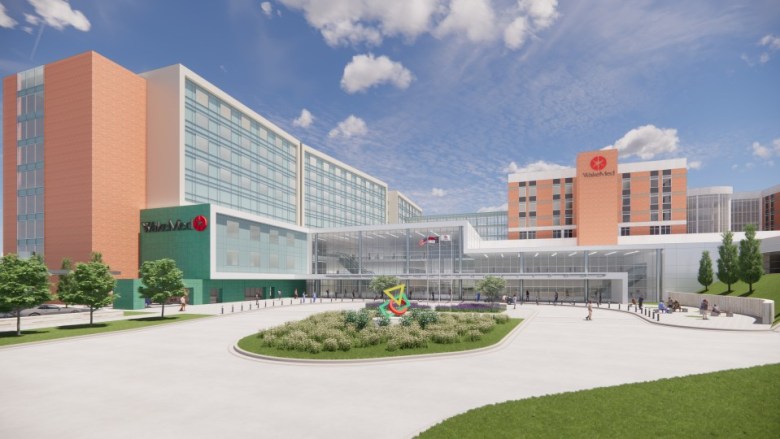
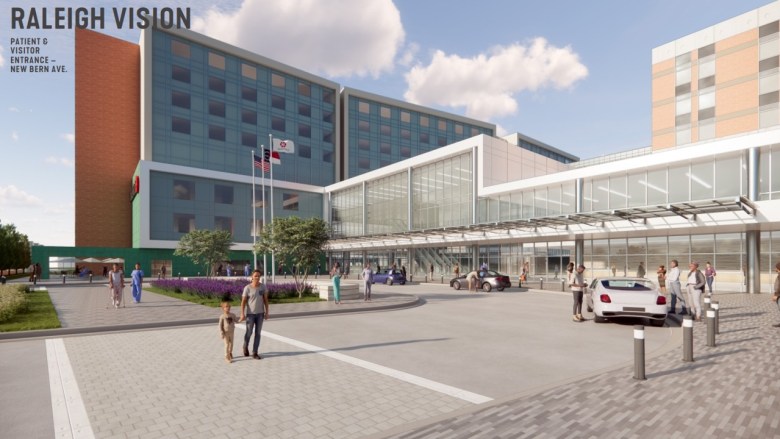


The plans to overhaul WakeMed’s New Bern Avenue campus, Gintzig said, fully depend on the county commissioners’ approval of the merger. WakeMed can begin planning this year if the deal is approved, but if not, “there’s no need in doing that, because we’re not going to have the money to start it in a very long time. … We will not, in my opinion, for the next 10 or 15 years, have the financial wherewithal to do all of that,” Gintzig said.
If plans to modernize the flagship campus do proceed this year, they’ll go hand in hand with a visionary partnership between WakeMed, Wake Tech, and Wake County that’s already underway.
The three entities coordinated with the City of Raleigh on a new Health and Education District, a shared vision for development and education that involved the county transferring land to WakeMed and Wake Tech for a new simulation hospital that will train students for careers in nursing, phlebotomy, radiography, dental hygiene, and other high-demand health care professions. The new hospital, located on Wake Tech’s Perry Health Sciences Campus adjacent to WakeMed, is on track to be completed next year.
“It becomes an opportunity … between our campus and Wake Tech’s campus where we have students going from our facility and Wake Tech, back and forth … for training and for classes,” Cavender explained. “As part of our agreement, [Wake Tech] has space to put one or two more classroom or education buildings on the Perry Health Sciences Campus.”

In addition to modernizing the Raleigh campus, WakeMed is planning to expand services at its hospital campuses in Cary and North Raleigh, and has filed applications with the state to build new hospitals in Rolesville and Wendell. It also has plans for a new healthplex in Fuquay-Varina.
Finally, over the next 15 years, WakeMed will build out a Whole Health Campus in Garner that will provide a 45-bed acute-care hospital integrated with a much-needed mental health hospital with 150 beds, private rooms, inpatient care and outpatient services, recreation and therapeutic services, and innovative treatments and therapies. Together, the two hospitals will cover roughly 410,000 square feet.
The campus will be built on 53 currently wooded acres located near the intersection of White Oak Road and Timber Drive, just east of Raleigh where Interstate 40 and U.S. Highway 70 intersect. The leafy location will provide a therapeutic environment for healing and recovery, Cavender explained, and both acute and mental health patients will access the campus via the same front entrance “without stigmatization.”
“We’re taking care of the entire body, mind, and spirituality for all patients,” Cavender said. “We believe it’s going to be the first of its kind, especially in the Southeast, where we’re blending acute care with mental health care.”
The combination with Atrium, leaders say, will allow for further development of services at that campus, and it will serve the whole region, including residents of nearby Southeast Raleigh.
In 1955, Wake County voters approved a $5 million bond to finance construction of Memorial Hospital of Wake County. It opened in its location on New Bern Avenue in 1961. The hospital was ahead of its time in that it would serve both Black and white patients. On April 25, 1961, Gale Dumas was the first baby born at the new hospital; she and her mother, Liza Ann Rogers Hall, were reportedly the hospital’s first patients. Prior to Memorial Hospital’s opening, St. Agnes Hospital, located on the campus of St. Augustine’s University in downtown Raleigh, was the only hospital in the region that would treat Black patients. It closed as Memorial Hospital opened its doors.
In 1997, Wake’s board of commissioners approved the sale of Memorial Hospital to Wake County Hospital System Inc. Now a private, nonprofit hospital system, Memorial was renamed WakeMed the following year, and two documents—an updated articles of incorporation and a transfer agreement—were created to govern the hospital’s relationship with Wake County, including the county commissioners’ role of making appointments to the board of directors.
Importantly, in the articles of incorporation, Wake County required WakeMed to provide services to all patients, regardless of their ability to pay, and required free care to those who can’t pay in an amount that totals at least 4.8% of the hospital system’s total annual revenue.
In fiscal year 2025, WakeMed reported approximately $2.62 billion in operating revenue while providing more than $370 million in charity care or community benefits—more than 12%, well over what the county requires of it.
Under the agreement with Atrium, WakeMed will still be bound to the same charity care requirement, and the patient pool that qualifies for assistance would expand from those living at 300% of the federal poverty level to 400%, meaning care could be free for a family of four earning less than $100,000 annually. Patients will also receive expanded access to virtual visits and speciality services such as oncology, neurosciences, and pediatric specialties.

As the Wake County commissioners consider the Atrium deal, WakeMed’s long legacy of charity care is top of mind for many Southeast Raleigh residents, as well as the leaders who are tasked with looking out for their best interests. The census tract that’s home to Big WakeMed and those surrounding it report some of the highest percentages of residents living below the poverty line in Wake County, as well as some of the highest unemployment rates countywide.
Anthony Pope is a Raleigh native and activist with the Men of Southeast Raleigh, a grassroots community group of about 80 members that’s dedicated to engaging with and advocating for the historically Black community, as well as preserving its history as neighborhoods in the city continue to gentrify.
Pope, who was “a kid at the time when the merger happened between St. Agnes Hospital and WakeMed,” said the majority of the Men of Southeast Raleigh oppose what they call the “takeover” of WakeMed by Atrium. They have concerns about Atrium’s track record, including a history of holding debt against patients for years and taking out liens against their property (in 2024, Atrium announced it was canceling thousands of past judgments, including wiping out liens on more than 11,500 of patients in six states, with some going back 20 years).
“Our main concern was that we had a voice to at least express how we felt about it,” Pope told the INDY in an interview. “A lot of times what happens in our … community is that there are a number of things on the agenda in terms of ‘we’re going to do this, we’re going to do that,’ but we are always late being informed. And by the time it gets to us, my opinion is that they’ve already made a decision. We’re just going to have these community meetings just to check the box to say we’ve met with you.”
Pope points to Ligon High School, a traditionally Black high school and historic site, that the school system decided earlier this year to tear down against the wishes of community members who wanted to preserve it.
“That’s just an example of how decisions are made,” Pope said. “‘We want your input,’ but then after it’s all said and done, we’ve already made a decision. And so that’s kind of how I feel about this.”
The loss of localized decision-making is a sticking point for residents like Pope. Atrium will gain control over WakeMed’s finances and operations and will broadly be able to change its governing documents without approval from the county commissioners. Any of the eight members that county commissioners appoint to Atrium’s board will come from a slate of nominees that two-thirds of the board already preapproved, and under the proposed articles of incorporation, Atrium would have the authority to remove board members.
Other residents and local leaders don’t think the benefits Atrium says it will offer are enough. Despite the promises of new jobs and the city’s major investment in the New Bern Avenue corridor, Raleigh Mayor Janet Cowell said she has serious concerns about the deal, especially about costs rising for residents of Southeast Raleigh and the secrecy surrounding the proposal.
Cowell compared the lack of a competitive bidding process to a situation this summer in which an out-of-state real estate firm offered the city $15 million to buy a parking deck it owns downtown near Moore Square. Residents and community groups swiftly voiced their concern about the impact on nearby businesses if the firm raised parking prices, forcing the city to acknowledge it was approaching the offer cautiously and emphasize that any sale would come with an upset bid process. The firm ultimately withdrew its offer.
“We had the situation with the parking deck, it was very different, but people complained about that process,” Cowell told the INDY in a July interview. “And I thought, ‘Wow. This is a parking deck. This is not life and death.’ … And here you’ve got your legacy, charity care hospital. And it’s got less [scrutiny] than a parking deck.
“That there is not a requirement for a more robust process is sort of stunning,” Cowell added.
Gintzig, WakeMed’s CEO, says he is sensitive to residents’ concerns about rising costs—which he says are inevitable whether the combination goes through or not—and secrecy, but he said many of the concerns come down to a fear of change.
“You’ve got to remember how they were hit with a surprise,” Gintzig told the INDY. “A lot of these things—you don’t spend a year talking through things. It creates uncertainty in the community and with the staff. There was the surprise, and then there was the initial headlines, ‘Atrium acquires WakeMed, Atrium takes over WakeMed.’ There was that mindset that created a lot of concern, because a lot of people in this community love WakeMed.”
While there is opposition from Southeast Raleigh residents to the combination, there’s also support, as speakers at the August public hearing made clear.
Demarcus Williams, the associate vice president of global marketing and communications for St. Augustine’s University, said in a statement from the leaders of the recently troubled historically Black college’s board of directors that SAU “is encouraged by the potential for an expanded health care ecosystem to create new opportunities in health care education, workforce development, clinical pathways, community health, and investment in Southeast Raleigh.”
Octavia Rainey, a lifelong Southeast Raleigh resident, echoed those sentiments.
“When [WakeMed brings] Atrium to the table, they can do all kinds of outreach, all kinds of service, all kinds of health care,” Rainey said.
Another Raleigh mayor, Cowell’s immediate predecessor Mary-Ann Baldwin, also spoke in support of the deal at the public hearing.
“When I learned that WakeMed was seeking a partner in Atrium Health, my immediate thought was ‘So this is what it’s going to take to ensure that WakeMed continues to grow and thrive,” she said. “I want to see that behavioral health hospital built in Garner. I want to see the campus thrive.”
As Raleigh and Wake County residents took the summer to learn about and debate the deal, Wake County commissioners have been quiet about which way they’re leaning on a vote that could be scheduled this month. They first learned about the proposal in a closed session in March, and agreed to delay the vote for 90 days following public outcry when it was quietly placed on their consent agenda in early May.
Out of the seven commissioners on the board, only Tara Waters, whose Southeast Raleigh district encompasses WakeMed’s flagship campus, responded to the INDY’s request for an interview.
Speaking in early August, before the public hearing, Waters said she has heard her constituents’ concerns about costs and process around the merger, as well as from those in favor of the combination. She said she was working to learn more.
“Based on the information that I have, there was communication with our appointed [WakeMed] board, and they felt comfortable with this combination,” Waters said.
“I really, really appreciate how vocal the community has been, particularly because I represent [the zip code] 27610, which is … rich in culture and history, but also in disparities around health care, around economic mobility, and I have heard a lot of people who have a lot of questions and who don’t feel comfortable with a strategic combination.”

In July, Mayor Cowell said WakeMed’s combination with Atrium may well be inevitable, but that “it would be nice if somebody said, like, could we open this process up to a more national competitive process … so that we could all see what is the best thing for this community, and is the proposal that’s on the table the absolute highest and best?”
It’s a suggestion that resonates with residents. At the public hearing, a resident suggested putting the question to the voters in a referendum. Another floated the creation of a straightforward government matrix to clarify who makes decisions about WakeMed’s future.
On the sidewalk outside of the Justice Center in August, Stephens, the pastor, said Atrium knows how powerful the public’s voice is, because it’s investing millions of dollars in billboard signs, TV and radio ads, Sling and YouTube ads, mailers, and direct calls to residents to try to convince them the deal is needed.
“They are desperate for this deal, because it is such a sweet deal,” he said. “It is far under market. … Open up the process. Give us a deal. You can support the idea of having a larger partner and not support this deal. … We think WakeMed is fine on its own right now, and is in a strong position. But, regardless, there is no rush. … Wake County, the deal is not done, we can keep fighting, and we can keep fighting after, no matter what happens.”
Comment on this story at [email protected].

You must be logged in to post a comment.