

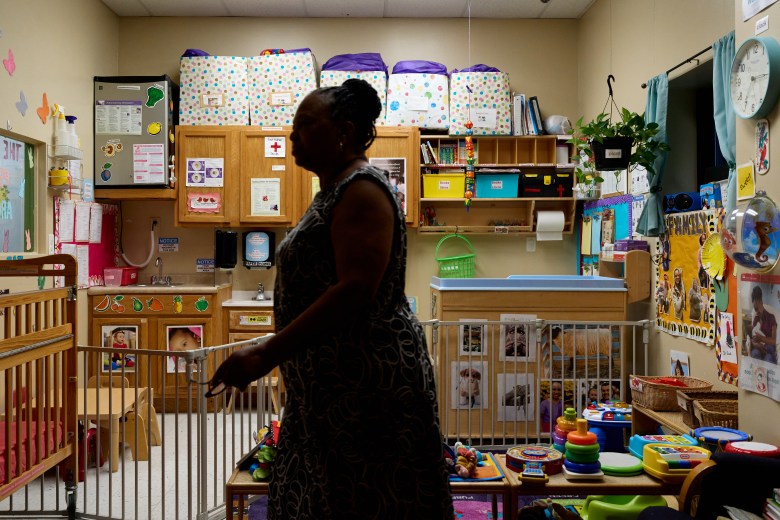
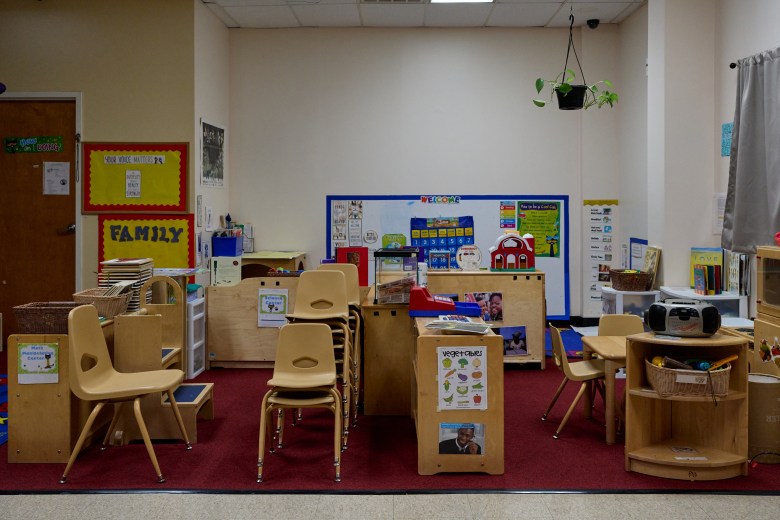
A mural of cheerful flowers in the hallway leads toward classrooms filled with toys, puzzles, and cribs for naptime. Letters spelling “Infants are a hoot” stretch across paper branches and owl cutouts on the wall, and new packages of diapers sit waiting to be used.
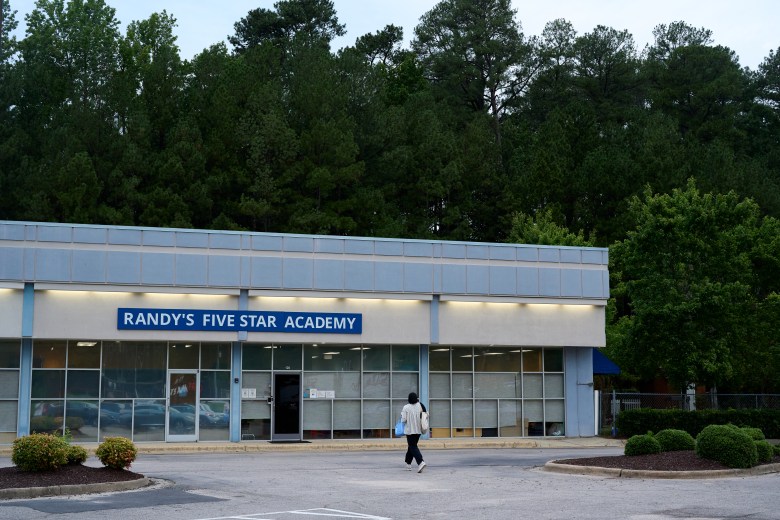
But the toys remain in their bins, and the cribs sit empty at naptime. At Randy’s Five Star Academy, a childcare center in Durham, Director Dalphia Murphy is having trouble recruiting and retaining teachers, which means the center can’t enroll up to its capacity. She is seeking an additional six providers in order to reopen four classrooms.
“I’m used to qualified teachers that really love children,” said Murphy, who had 19 teachers on staff before the pandemic and now has seven. “That’s the only thing I know. But what I see now is that no one wants to work.”
Before the pandemic, nearly 80 children attended Randy’s Five Star Academy. But this summer, provider shortages mean only 22 are enrolled, with another 16 having graduated from the pre-K program in May.
Childcare centers like Randy’s received federal funding during the pandemic to pay teachers, and that money ran out in 2025, contributing to closures in Durham and across the state. As of August 10, 135 families in Durham have been approved for subsidized childcare but are waiting for a seat to open up due to a lack of providers among childcare centers that accept subsidies, said Tonia Gay, who manages the subsidies at the county’s Department of Social Services.
At Randy’s, teachers have felt the impact of turnover firsthand, filling in for classrooms where they can and going without coverage when they’re sick. Most students at the center come from low-income families and receive subsidized tuition. Teachers say the job is a hard but necessary investment in the children’s future.
“Some kids, maybe they don’t get that security at home,” Debbie Timmons, who teaches pre-K at Randy’s, said. “So us teachers, we basically are maybe second parents to these children, giving them the nurture and the guidance.”
A System of Subsidies
In Durham, parents can apply for childcare subsidies through one county application, and then a group of local childcare agencies match a child to a center. The subsidies go to a childcare center to discount or eliminate the cost of attendance, depending on the program and a family’s income eligibility.
A combination of local, state, and federal funding supports these subsidies.
Early Head Start and Head Start are federally funded programs for low-income families. They collectively serve ages 0 through 5 for free for qualifying families.
Families who don’t meet the Head Start income threshold can instead qualify for the state’s subsidy program, which can be used at independent childcare centers that accept them. The state mandates that families receiving the subsidies pay 10% of their income to the childcare provider.
The NC Pre-K Program is state funded, and it serves 4-year-olds at no cost to income-eligible families. Durham PreK is a county-funded initiative for all 4-year-olds, with a priority for students who are “at risk,” meaning they exhibit medical, financial, or academic instability. It is free for families making under 450% of the federal poverty level, and families making above that pay 2% of their monthly income.
Each of these programs partner with childcare centers to offer seats, so one pre-K class may have some seats funded by the state and others by the county, for example.
Overall, there are 2,059 families using some form of child care subsidies in Durham, according to Gay at DSS, making up about one third of the total child care seats for this past school year.
Linda Chappel, who leads efforts to improve childcare equity and access in the Triangle at Early Years, said the funded system is “blended and braided” in order to create as many seats as possible.
Even with this funding model, Durham’s childcare industry is feeling the blow from the elimination of COVID-era grants.
Kate Irish, executive director at the nonprofit Durham’s Partnership for Children, said the COVID-era stabilization grants helped keep childcare centers afloat. As teacher shortages persist in K-12 schools across the county, independently owned childcare centers find it especially difficult to keep up.
“If you have a teacher turnover and you need to keep that classroom going, you still have to pay,” Irish said. “You still have to make it work. So having those funds was what really enabled them to have any kind of room to breathe.”
Shabaka and Darlene Brannon, two partners who run Kids Korner Academy in central Durham, used the grants to support payroll and overhead costs, receiving about $85,000 quarterly from the federal government. With the funds, they raised their teacher pay that ranged from $13 to $16 per hour before the pandemic to more than $21 per hour, gave their teachers bonuses of up to $500 per paycheck, brought families meals, and once, helped a family who had become homeless live in a hotel for two months.
But once that funding was pulled in 2025, the Brannons did not want to reduce salaries, and they were left scrambling to make up the costs.
“Even the light bill has gone up, the water bill, utilities—everything has just gone high sky,” Darlene said. “Everybody is being punished in a way, but we’re all hurting.”
Kids Korner isn’t the only place that struggled after grants were eliminated; North Carolina lost 367 licensed childcare centers between February 2020 and December 2025, EdNC reported in January, with the net loss increasing after the stabilization grants ran out.
All of the seats in Kids Korner Academy are eligible for subsidies. But for parents who can’t pay 10% of their income, the Brannons front the costs—using their personal money and taking out credit to pay their staff.
Durham parent Tiffany Payton received subsidies to enroll her son in Kids Korner Academy, but she said she struggled sometimes to pay the $300 per month in fees. While her son was eligible for NC Pre-K, which is free to parents, the school day ends earlier than Payton gets off work, meaning she had to keep him in private daycare.
Some kids, maybe they don’t get that security at home. So us teachers, we basically are maybe second parents to these children, giving them the nurture and the guidance.
debbie timmons
Payton said Darlene has been accommodating during months where she’s had to pay the fee late or couldn’t front the money at all.
“It’s not that I don’t want to pay, I just literally don’t have it,” Payton said. “They waived the fee twice since he’s been there, and I try not to do that because I know they already don’t get paid enough, and then to not pay is like, OK, you’re cutting in on their money even more.”
High Costs, Low Pay
The county’s goal is for subsidized preschool programs to serve 75% of 4-year-olds in Durham, Chappel said, but there are currently seats available for 41% of that population. In order to reach its goal, Durham will need to strengthen its childcare workforce.
Each class must follow teacher-to-student ratio requirements set by the state, and without providers, the classes cannot reach capacity. At Randy’s Five Star Academy, an additional pre-K and infant class each need two providers in order to open, and an Early Head Start and Head Start class each need one more provider to fill all of the seats.
Childcare operators and advocates who spoke to the INDY attributed the lack of providers to low salaries and limited benefits.
Murphy pays her newest and least experienced provider $12 per hour, and another who has a degree and has worked in childcare for more than a decade earns $24 per hour. Murphy said most of her employees decline benefits because they can’t afford to take a piece out of their salaries each month.
But with high operational costs, it’s difficult for childcare centers like Murphy’s to increase teacher pay. The cost of building space, equipment and supplies, food, and strict staff-to-child ratios drive up the costs of attendance, even as providers aim to keep them low for families.
“They deserve to get more money,” Murphy said about her teachers.
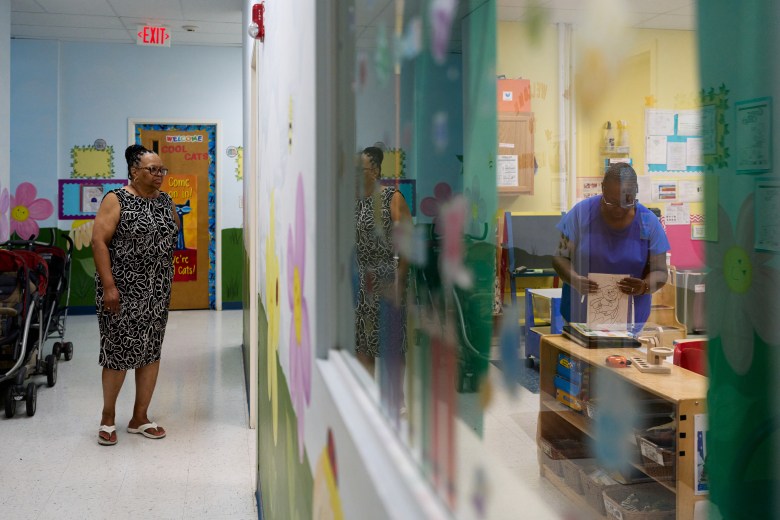
Director Dalphia Murphy (left) talks to Gloria Smallwood as she prepares her classroom at Randy’s Five Star Academy on July 22, 2026. Credit: Photo by Matt Ramey 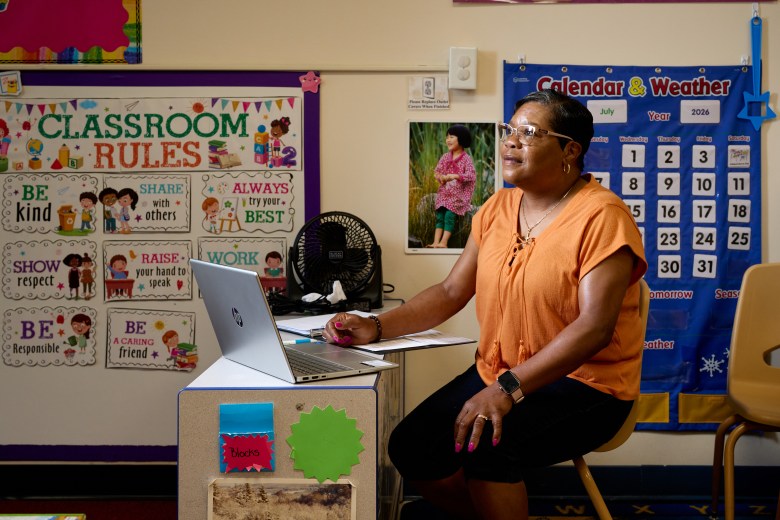
Debbie Timmons, a pre-K teacher at Randy’s Five Star Academy, has taught for more than a decade. 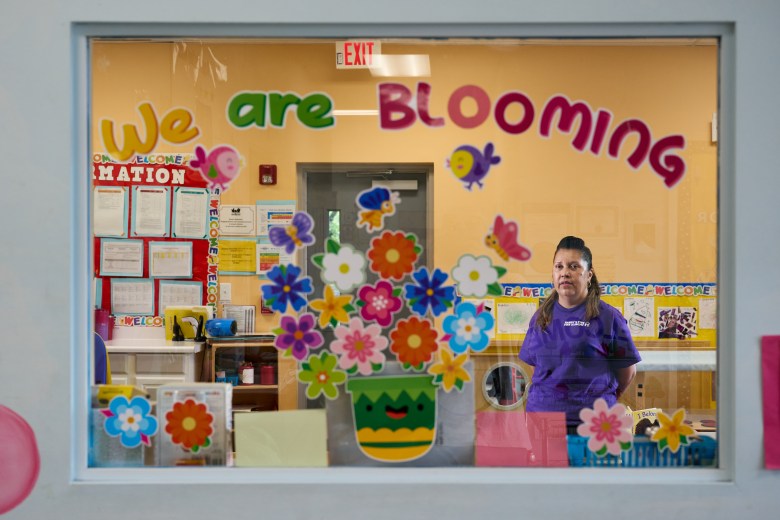
Yanett Martinez is working to become a lead teacher at Randy’s Five Star Academy. Credit: Photo by Matt Ramey 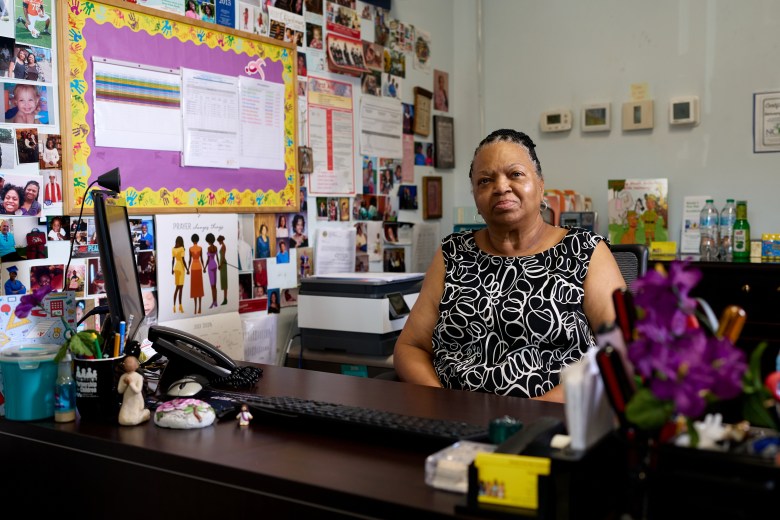
Randy’s Five Star Academy Director Dalphia Murphy poses for a portrait. Credit: Photo by Matt Ramey
Providers are eligible for pay raises depending on their credentials and the program they teach. The Durham PreK program requires that every lead teacher must have or be working toward a Birth-through-Kindergarten License and get paid at the Durham Public Schools pay scale. But Chappel said the public school compensation package is still much stronger with better benefits.
Timmons said she spends about five hours per week outside of work preparing for class. Teachers also administer two meals and a snack each day and conduct health checks for students. She could not recall ever taking a personal day, and she said there are no teachers available to cover for her if she did.
When Murphy interviews potential employees, she finds that they can work in the restaurant industry or another hourly job where they don’t have to do as much preparation or adhere to such strict standards. Murphy said it’s hard to find staff who are passionate about early childhood education. The childcare center has a five-star rating from the state, which it earned for adherence to high standards of care.
Murphy said if she could hire just one additional teacher as a floater, that could help with coverage if teachers had to be out.
“They really need mental health breaks,” Murphy said about her teachers. “I know I do, and I’m the director. But they really need it, because sometimes it’s rough on a person.”
Yannett Martinez, a teacher at Randy’s, said it’s stressful to frequently train new teachers and deal with the related paperwork only for some teachers to leave after a few weeks.
Even the light bill has gone up, the water bill, utilities—everything has just gone high sky. Everybody is being punished in a way, but we’re all hurting.
darlene brannon
A study published by the National Institutes of Health in 2024 found that emotional and behavioral problems among preschool children increased during the pandemic. Terry David, executive director at the Durham nonprofit Families and Communities Rising, said that promoting wellness and increasing in-classroom support is just as important as fair pay.
“Since COVID, I’ve seen more children who have challenging behaviors, or children who may need additional support—so making sure there’s support in the classroom for teachers, not just giving them breaks, not just wellness, but in addition to that, providing an environment where psychological safety is present,” David said.
David said he’s seen the childcare workforce destabilize after the pandemic as federal funding for the industry has declined. Because Head Start is federally funded, increases in teacher salaries at the state level have not translated to Head Start programs. Head Start programs across the state had to pause operations during a federal government shutdown in 2025, and earlier that year the Trump administration proposed eliminating funding for the program, prompting several state officials to write a letter to Congress opposing the cuts. The Trump administration is currently planning to strip the program of its standards of care, leaving the rule-making up to states.
“Head Start is federally funded, and it’s not a priority of the administration. Some people have left the field because they don’t feel that this field, long-term, may serve their best interest,” David said.
The demand for seats in infant and toddler classrooms is particularly acute, said Jameka Wells, director of programs at Durham’s Partnership for Children. Those classrooms require more teachers per child, meaning the operational cost is higher and there are fewer seats available for every teacher. She said a lack of qualified staff for those classrooms leads to extensive waitlists, leading parents to get creative with childcare and rely on family and neighbors.
When Durham parent Shanika Paylor was pregnant with her second child, she was already asking her older son’s childcare center for a spot in the infant class. But by the time her daughter was ready for daycare, the waitlist was eight to 12 months long. Paylor relied on her family nearby and took advantage of a flexible work schedule to work from home when she needed to. Ultimately, Paylor found a spot for her daughter at a different center, splitting up her children in order to find full coverage.
“When I think about even taking two kids to two separate childcare centers, I’ll take it,” Paylor said. “Maybe that’s parental desperation.”
In centers that do have seats available, there are often even fewer options for families that use child care subsidies. Chappel said many providers do not accept subsidies because the state reimbursement rate is often lower than the costs of care.
According to Chappel, the average cost of a five-star infant child care seat is $20,332 annually, which makes up nearly a quarter of the median household income in Durham.
Paylor said she applied for subsidies for her daughter and is waiting to hear if she will be eligible. In the meantime, Paylor pays $1,400 per month—and she said she did “a lot of work trying to find that price.”
Investing in the Future
To help recruit and retain teachers, Early Years offers scholarships through its TEACH program for early childhood providers to obtain degrees and certificates, and the nonprofit supplements teacher salaries through its WAGE$ program, which offers higher pay for increased levels of education. Murphy encourages all of her staff to seek higher levels of education, and providers’ education levels contribute to the center’s five-star rating.
Martinez, the Early Head Start teacher at Randy’s Five Star Academy, received funding through TEACH to obtain a Child Development Associate certificate and is working toward her bachelor’s degree through an online program at UNC Greensboro.
Martinez said she was the second teacher to graduate from the Early Years apprenticeship program, and she now serves as a mentor to students. But she hears from her mentees that going through a degree program is a lot of work for a job with low pay and limited benefits.
“It’s a lot to learn for somebody new,” Martinez said.
Martinez hopes to soon become a lead teacher in the pre-K class, which comes with higher pay.
Durham is one of few counties in the state that funds its own pre-K program, Chappel said. It launched in 2018 with a goal of providing universal child care for four-year olds. Ninety students enrolled in its inaugural year and it has grown each year since, to nearly 900 seats in DPS classrooms alone for the 2025-26 school year, with additional funding supplementing seats at private centers.
When Paylor’s son aged into pre-K, she said it was “total financial relief.” Paylor’s son entered publicly funded pre-K at the same time Paylor’s daughter began infant care. “We literally thanked our lucky stars,” Paylor said, that she wouldn’t have to pay for childcare for two kids at the same time.
The county’s pre-K program has demonstrated evidence of its success, with more than nine in 10 students achieving or exceeding academic expectations.
But for this upcoming school year, Durham PreK had to cut 34 seats due to county budget restrictions. Chappel said there also may be cuts to pre-K seats that are partially funded by the county.
“It’s a modest cut based on the overall number of seats in the community, but any cut is unfortunate,” Chappel said.
The county also initiated a project in 2020 to try to increase seat availability for infants and toddlers, and it included plans for a childcare center at the Renegade, an affordable housing complex on Main Street, that opened in 2025. Chappel said more than a dozen child care operators applied to operate in the space, but ultimately the top five candidates could not afford the building costs and market-rate lease. The county is still working to finding a child care operator for the space, she said, but there are no active prospects at this time.
The state budget passed in July allocated $97 million in recurring federal funding to raise subsidy rates across the state, primarily benefitting rural counties. In Durham, childcare experts don’t yet know exactly what that will mean for Durham’s providers, said Wells at Durham’s Partnership for Children.
“The providers have a lot of competing costs for sure, but we’re hoping that that ends up meaning that programs will be able to pay their teachers a little more to try to retain them, because it’s definitely in their best interest, too, to do that,” Wells said.
Comment on this story at [email protected].
Correction: A previous version of this story misspelled Payton as Tayton and Kids Korner as Kids Corner.

You must be logged in to post a comment.