

This is an excerpt from Miracle Road: The Story of Research Triangle Park. It is published with permission from Duke University Press.
While watching a Battlestar Galactica episode on a long plane flight in 2008, Ned Sharpless, a polymath oncologist at the University of North Carolina at Chapel Hill, was struck by the ingenious weapon the show’s villains had deployed to destroy space travelers from Earth.
They were using particle beams of ionizing radiation that could penetrate human bone marrow to attack the stem cells proliferating inside and, ultimately, shut down the body’s repair system. It occurred to Sharpless that chemotherapy had much the same effect on his patients.
He began asking himself questions: Could a new drug be designed to protect stem cells inside bone marrow from the ravages of chemotherapy? Could the new drug induce a quiescent state in which red and white blood cells were put to sleep? Could chemo treatments then continue without delays for patients to recover from its debilitating side effects? Would tumors stop growing while patients took the drug?
In many ways, the most daunting question of all was: Could such a drug be commercialized and mass produced to treat the 1 million Americans taking chemo in any given year and many millions more in treatment abroad?
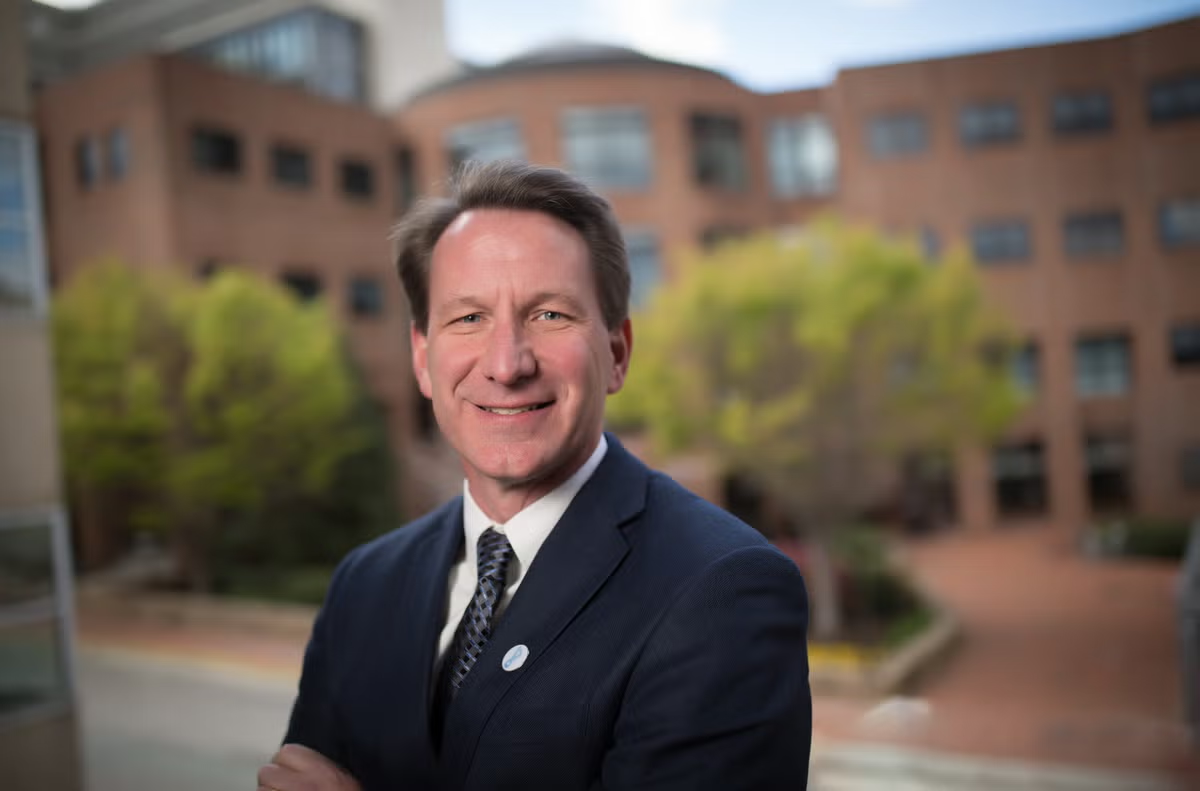
Sharpless, widely known as a visionary with an empathetic heart, was a professor at UNC’s Lineberger Cancer Institute and later became its director. In 2017, he became director of the National Cancer Institute and served two years as acting commissioner of the U.S. Food and Drug Administration.
Not long after his epiphany on the plane, Sharpless and Kwok-Kin Wong, who’d been a fellow postdoc at Harvard Medical School, cofounded a company called G-Zero Therapeutics, so named for the quiescent cell state to be induced by the proposed new drug. In attempting to commercialize what amounted to little more than an idea, Sharpless and Wong faced a development cycle that could take up to 15 years and cost tens of millions of dollars.
But their bold step set in motion a perpetual drug development cycle of seed and angel funding to validate the idea; funding rounds to bring in outside investors; extensive—and high-cost—studies to make sure the drug is safe for humans; clinical trials supervised by the FDA to obtain regulatory approval; ramp-up funding from large equity investors and/or a public share offering; mass production and marketing; and, finally, new scientific discoveries.
Suffice it to say that superb scientific and business expertise had to be deployed at every step. Fate and sound judgment guided Sharpless in making a first hire. Right out of the gate, so to speak, he found someone who would profoundly shape the company’s science going forward and add much depth to his idea.
In the midst of the 2009 financial crisis, the pharmaceutical giant GlaxoSmithKline (GSK) laid off 10,000 employees, including many scientists at its U.S. headquarters in Research Triangle Park. Jay Strum, a biochemist who’d been with the company for 15 years, was among those let go. At the time, he was part of a GSK international team working on a project at Harvard. A Tar Heel by birth, Strum earned a Ph.D. in biochemistry at Wake Forest University and did a postdoc in molecular biology at Duke University. After wrapping up his project in Boston, he returned to the Triangle and began looking for a job.
Soon after, Strum learned through a friend of a friend that Sharpless needed a biochemist. He called right away and reached Sharpless in Greensboro, where he’d taken his kids to a soccer tournament. After they established that they knew many of the same professionals, a rapport began to build. Sharpless even knew a coworker of Strum’s from his last GSK assignment at Harvard.
“How come we’ve never met?” Sharpless asked.
Strum could hear a loud rumbling noise on the other end of the line but managed to answer, “I’m not sure. … ”
“Listen!” Sharpless shouted. “My muffler is falling off. I’ll call you as soon as I get home.”

True to his word, Sharpless called about an hour or so later. He’d already called two professionals who both knew Strum, and both had glowing things to say. One even told Sharpless, “If you don’t hire him, I will.” Strum soon became G-Zero’s first employee and its chief scientific officer.
“I’ve always believed fate had a hand in all that,” Strum reflected 15 years later. “Just think about it: A friend of a friend, who barely knew me, just happened to bump into Ned, learned that he had a job to fill, and then connected us. What if Ned’s muffler had fallen off? It might have been a different story.”
The Meticulous Work of Molecules
Strum’s first task was to design a new molecule to, in effect, put bone marrow cells to sleep. Designing such a particle is scientific discovery verging on art. Most drugs on the market are small molecules—low-weight organic compounds designed to trigger a biological response in the human body.
Designing a molecule is meticulous work; they often take years to develop and patent. In some instances, designing and manufacturing a small molecule can cost billions of dollars.
G-Zero was incubated in Sharpless’s lab at the UNC Lineberger Cancer Center. Two more scientists came aboard early—postdoc Patrick Roberts and John Bisi, who’d worked at GSK and had become a senior scientist.
Strum, Roberts, and Bisi all squeezed into one small room with wobbly desks, with the dual task of finding a small molecule and securing more funding to continue their research. Soft loans from NCBiotech, totaling $500,000, bridged the gap to major, much-needed competitive grants. Between late 2009 and mid-2012, the firm won government grants worth $3.6 million.
“Just think about it: A friend of a friend, who barely knew me, just happened to bump into Ned, learned that he had a job to fill, and then connected us.”
Jay Strum, biochemist
These funds enabled the team to identify and patent a candidate small molecule and also to patent a treatment for the deadliest form of lung cancer, one so aggressive that most patients die within a year of diagnosis. By then, the firm’s funding needs had outstripped what grants could provide; venture funding was essential to keep expanding.
Even before G-Zero formed, Sharpless had approached Clay Thorp, an investor who’d made a lot of money by age 30. He and co-investors had spent four years in the late 1990s developing a drug discovery platform that got sold to a Swedish firm for $106.7 million in stock. Instead of relaxing on the beach, Thorp decided to pursue a recurring dream: “to start a firm that would start new companies.”
Thorp gave the new enterprise a distinctive metaphorical name—Hatteras Venture Partners, so named for the Cape on the North Carolina coast facing Diamond Shoals, where countless ships have gone under. Since 1803, the Cape’s famous lighthouse has guided ships through heavy storms. Instead of ships, Hatteras Venture Partners would steer startups and more advanced companies through the stormy seas of the business cycle. The Durham-based group would go on to become one of the largest venture capital firms in the Southeast, investing in 93 medicine and life science companies. In many instances, its senior management would serve as their acting CEO.

In 2009, Sharpless and Thorp first discussed G-Zero. Sharpless pitched a molecule he hoped to option from Pfizer under a material transfer agreement.
“Very impressive,” Thorp allowed. “Is it your molecule?
“No,” Sharpless replied. “It belongs to Pfizer.”
“Well, that’s not going to work for us. We’re not a charity.”
But Thorp’s interest had been piqued enough to call a former colleague at the Pfizer Venture Fund to ask about the molecule’s availability.
“You must be smoking something,” he was told. “We’re not going to let you option that molecule.”
At the time, neither Sharpless nor Thorp knew that Pfizer was on the verge of initiating clinical trials for its molecule for treatment of a hormone receptor for positive breast cancer diagnosis with potential to extend patient lives significantly. The molecule would become Ibrance, a multibillion-dollar drug.
After his call to Pfizer, Thorp told Sharpless, “Listen, we’d love to help you, but we can’t.”
Sharpless didn’t take that as a flat turndown. Thorp clearly understood the molecule’s scientific potential—and that it addressed a big market—so he kept updating him every six months or so. Finally, in 2010, Sharpless reported that he’d hired Strum: “Jay’s going to help me find a molecule with the properties I told you about.”
From Idea to Commercialization
In the all-out search for venture capital that followed, Sharpless and Strum pitched many funds but got no takers; their pitch was met with glazed eyes and bored looks. While they kept updating Thorp on their efforts, his position remained the same: HVP would not invest until they owned the rights to the molecule’s intellectual property.
By 2012, G-Zero owned a library molecule (one used to study gene function) that showed impressive results in animal models, indicating it could protect bone marrow from chemotherapy and radiation damage. The molecule also showed promise with small-cell lung cancer, a devastating disease caused by smoking. The breakthrough impressed Thorp and others at HVP—as did G-Zero data on preclinical trials with animals.
“We’d like to invest, but we can’t invest in anything with a zero in its name,” Thorp finally told them. “That would be the same as investing in G-Loser.” They agreed to rename the company G1, for the phase in the cycle when cell replication gets put on pause.
“Whatever you do,” Thorp gibed, “don’t spell it g-o-n-e or gone. That sounds about as bad as G-Zero.”
HVP invested $600,000 in the newly rechristened G1 and got a 25% stake in the company. It was the only investor except for Sharpless’s mother, who’d put in $100,000.
Thorp also took a seat on the board but planned to add something more: “You want our money,” he told G1 principals, “but now I think you really need our leadership.” Impressive scientific accomplishments would only take them so far; minefields lay ahead in rigorous FDA clinical trials. They also needed seasoned business know-how to raise millions more and get the drug manufactured and sold.
“You want our money, but now I think you really need our leadership.”
Clay Thorp, investor
Thorp knew exactly who to turn to: Christy Shaffer. Shaffer joined HVP in 2011 as managing director of the fund’s seed investment program and had remarkable success at Inspire Pharmaceuticals, where she became the first full-time employee in 1995. As president and CEO, she’d grown Inspire to 250 employees and revenues of $100 million. After taking the company public in 2000, she had raised a total of $300 million, and The Scientist magazine had named it a “Best Place to Work.”
Shaffer had a background and skill set that gave her instant credibility with G1 scientists. She had a Ph.D. in pharmacology and had held senior-level positions at Burroughs Wellcome, a firm widely admired for its groundbreaking discoveries in the life sciences. Her HVP colleagues jokingly dubbed her “the kindergarten teacher” because she excelled at helping top-flight scientists cope with arcane mysteries of the business cycle. In 2012, she became executive chair of the G1 board with oversight over preparations for FDA clinical trials. The odds against success in that endeavor were long: Taking a drug to market could cost a billion dollars, and 90% of applicants failed.
Shaffer began meeting weekly with G1 principals to assess progress toward major milestones. G1 would incur significant outlays to fund studies on the effects of the proposed drug on animals and humans. A single mouse study could cost $50,000. Tests on humans cost much more.

Consultants and/or a contract research organization would be needed at various stages of FDA clinical trials. Shaffer had many contacts to leverage. She and Thorp also pitched many funding sources. When a G1 scientist questioned why so many, she replied, “You have to kiss a lot of frogs to find a prince.”
Under Shaffer’s leadership, G1 moved forward at a pace that shaved years off the development cycle. In her first year, they secured $12 million in Series A capital, preferred stock that institutional investors buy to implement a plan to generate long-term profitability. The National Cancer Institute provided $2.5 million in 2013.
A year later, G1 moved to RTP, and Shaffer turned the reins over to G1’s first full-time CEO—Mark Velleca, who had both a medical degree and a Ph.D. from Washington University in St. Louis. Over the next six years, he’d achieve major milestones that kept G1 on its rapid trajectory, including Phase I through II clinical trials that led to FDA approval of G1’s molecule and successful Series B and C funding rounds that kept G1 on track for an IPO. It sorely needed one to underwrite the high-cost testing that lay ahead. The product’s scientific name was trilaciclib, a first-in-class advanced immunotherapy sold commercially as Cosela.
The Glaxo Effect
G1 went public on May 16, 2016, when Velleca rang the opening bell at the NASDAQ Stock Exchange in New York. Facing the luminaries of the financial press—Bloomberg, Reuters, CNBC—Velleca briefly described how trilaciclib would get a substantial share of the market for marrow protection in small-cell lung cancer. His remarks drew enthusiastic applause from the 20 G1 employees in attendance. Management had decided to take everyone to the opening, even a few who’d just been hired.
G1 shares opened at $15 with the company raising a whopping $105 million, far more than the company contingent expected. Within 18 months, the stock was trading at $67 per share. Thorp called it “a home run by any measure.”
That night, the G1 entourage celebrated with high spirits in a private room at Oscar-winning actor Robert De Niro’s Tribeca Grill. After outrageously expensive oysters, a second IPO might well have been called for.
“You have to kiss a lot of frogs to find a prince.”
Christy Shaffer, partner at Hatteras Venture Partners
Relationships based on resolute trust truly matter in the venture capital arena. VCs convince high-net-worth individuals and institutions to commit, say, $1 million and sign a subscription agreement. The call on that investment is at the VC’s discretion, and the VC gets 20% of the profits. But that may be a long time in coming, as the G1 timeline illustrates: As of 2024, Cosela was projected to have about $70 million in sales.
Informal networks also matter. While the Glaxo layoffs in 2009 were devastating for those let go, an unpredicted impact was the advent of a much stronger entrepreneurial culture in RTP—what is loosely called the “Glaxo effect.” In essence, people like Strum and Bisi went out and started new companies.
Several times in interviews for this book, Strum used the word “fate” as a synonym for “unexplained event”—moments like Sharpless’s epiphany on the plane or the “miracle” of the grandmother who gets an extra five years to live.
Asked if he has a spiritual side, Strum says he’s been a lifelong believer. He never argues about the existence of God; instead, he points out that “there has to be a painter if there’s a painting. Everything is so ordered that with a bit more gravity, the universe would implode; with a little less, it would fly apart rapidly.”
“It’s hard for me as a scientist to study molecule design and not see a cosmic painter’s hand at work,” he adds. “Why else would creation exist? Why would we even be here?”
The North Carolina Biotech Center is hosting a book launch and signing on October 13. Find out more here.

You must be logged in to post a comment.