

Earlier this month, more than a year after halting exhibitions and laying off staff, the Contemporary Art Museum of Raleigh (CAM) announced plans to sell its iconic building downtown.
“Our mission is bigger than our walls. So, we’re selling ours,” read an Aug. 3 statement posted on Facebook from the CAM board of directors. “409 West Martin Street is going on the market.”
CAM’s property is currently listed for sale online by real estate broker CBRE. The land and building were worth around $11 million as of January 2024, according to Wake County real estate records, although it’s unknown how much the property may sell for. With the property zoned for up to 40 stories, redevelopment is likely.
Public reactions to this announcement post were mixed, to say the least. Many commenters were disappointed, recalling their favorite exhibits at the space or writing about how important CAM—as an institution, and as a building—was to the Warehouse District.
Pete Sack, co-executive director of the Visual Arts Exchange (VAE) in downtown Raleigh, told the INDY he was disappointed to see CAM sell, especially given the building’s unique architecture.
“You’re losing something visually beautiful that is different from any other building downtown,” Sack said. “Just aesthetically, it’s something that’s unique to downtown. It feels like the writing’s on the wall, that building may not last.”
Other Raleigh residents took a more accusatory tone, questioning whether the board could have done more to preserve the brick-and-mortar museum and asking for specifics about CAM’s future plans. (Other commenters, meanwhile, criticized the tone of the post, speculating about whether it was written by AI.)
“The announcement was a lot of the same, you know, ‘We’re looking forward, we’re gonna do something bold and new,’” Joel Tesch, a contemporary painter based in Raleigh, told the INDY.
After CAM’s 14-month hiatus, Tesch hoped the board would have more concrete details to share about their plans: “I am worried that they’re just going to vanish,” he said.
In the post, CAM’s posture was optimistic, writing that the museum “isn’t saying goodbye. We’re setting the stage for our boldest chapter yet.” But when the INDY asked board chair Charman Driver what the chapter would look like, details were scarce.
“We can’t confirm a specific model yet, but we want to be clear that a lot of hard work has already gone into figuring out what’s next,” Driver wrote in a statement to the INDY. “At the end of the day, reinventing ourselves in a sustainable way matters more to us than anything else. We want to be here for years to come.”
But with more than a year having passed since CAM initially announced a hiatus, and no concrete plans, the question remains whether an institution with an identity so deeply tied to its building may be able to have staying power without it.
“Always conversation starting”
CAM has a bumpy history. The museum originally grew out of the ashes of the City Gallery of Contemporary Art, which shut down in the 1990s when the Raleigh City Council pulled its funding. Frank Thompson, a local businessman, led the organization’s former board to buy the building on West Martin Street in 1997 for $460,000, with plans to renovate.
CAM began holding exhibitions around 2002, but it took more than a decade of fundraising and advocacy for Thompson’s vision to come to life, with the reimagined building opening in 2011.
Since then, the museum has operated with a rotating cast of executive directors: five in 15 years. In 2018, the museum ran into a major controversy after displaying a white painter’s racially charged work, depicting Black subjects with white paint on their bodies.
Related stories


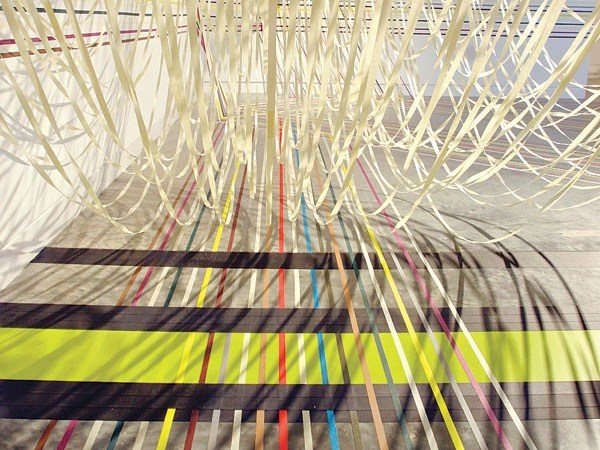
CAM was originally conceptualized as a place to exhibit contemporary artists from around the world, bringing highly acclaimed work to Raleigh and filling in a gap in the arts scene. Cutting-edge artists like Marilyn Minter and Leonardo Drew exhibited there.
Tesch, also a longtime visitor, remembers a noteworthy 2011 Rebecca Ward exhibit fondly. “It was an awesome example of what contemporary art can be,” he said.
Later, CAM shifted to exhibiting more North Carolina artists, including through an annual show in partnership with the Raleigh Fine Arts Association. Even if an exhibit at CAM was something you didn’t like, “it was always something to talk about,” Tesch added. “It was always conversation starting.”
Radio silence
After CAM stopped exhibitions and programming in June 2025, there was a lot of “internal back and forth looking at our financial models,” Vice Chair Kate Ferguson Boes said in a phone interview with the INDY. “You know, ‘Can we afford to keep the building? Where do we need to go?’”
In January, about six months after the closure, CAM hired an outside consultant, who took the board through a monthslong research process. That led the board to the decision to sell the building, as well as a few “potential scenarios for CAM’s future,” according to Driver.
Selling the building “was a financial decision, but at the same time, it’s not a fire sale,” Boes said. A sale, and the revenue that comes with it, “opens up a world of possibility for the organization,” she added.
“We could absolutely keep trudging along, but it narrowed us too much,” Boes said. “We wanted to be really mission first, and truly centered around impact versus massive overhead.”
Over the next month, the board will talk about the feasibility of implementing each of the potential plans they’ve developed, according to Boes.
“This museum is too important to downtown Raleigh to let it go on autopilot.”
joel tesch, contemporary artist in raleigh
Still, several local artists are frustrated by what they see as a lack of communication from CAM—including Tesch, who said he hasn’t seen much in the way of community engagement.
“When you are taking that responsibility, you have to communicate and engage the audience,” he said. “This museum is too important to downtown Raleigh to let it go on autopilot.”
Jean Gray Mohs, another working artist, acts as co-executive director of VAE . She said she didn’t think the silence from CAM was “to their benefit.”
“I just imagine that if the community had been invited in, this may have gone differently,” Mohs said. “I was shocked and not shocked when I heard the news. I’m not sure what a museum does without a building. Hopefully they’ve got some things coming that we just aren’t privy to yet.”
“I can say unequivocally, without a doubt, that CAM is not going to vanish. There’s 17 board members who are actively engaged,
Kate Ferguson Boes, vice chair, cam board
and not a single one of us
wants it to vanish.”
When asked about the radio silence, Boes said CAM’s lack of staff made widespread engagement challenging. The museum employed seven staff members before halting operations in 2025. But since then, everything has been left up to the board, made up entirely of volunteers. Most also work full-time, Boes added.
Boes said she aims to be more transparent going forward, and that details about CAM’s future plans may be on the way toward the end of September.
“I can say unequivocally, without a doubt, that CAM is not going to vanish,” she said. “There’s 17 board members who are actively engaged, and not a single one of us wants it to vanish.”
A struggle to raise revenue
As a nonprofit, the museum survived with the help of donations and government grants, including from the City of Raleigh.
Still, CAM began posting net losses in 2017, during executive director Gab Smith’s tenure, according to IRS records. Although the museum’s revenue increased from 2016 to 2017, its expenses more than quadrupled that same year, as the organization spent much more on exhibitions, operations, and staffing.
In addition to paying artists and covering the costs of shipping and storing artwork, the museum spent money on operating expenses like legal and accounting services, building upkeep, and interest payments. CAM’s annual losses continued through at least 2023—persistent through the COVID pandemic and despite a change in leadership.

The museum “faced a recurring gap between the cost of operating the museum and the revenue available to support it,” according to Boes. “The pandemic and an increasingly competitive funding environment added to that pressure.”
Although CAM owns its 20,000-square-foot building, “the maintenance, repairs, utilities, insurance and general upkeep had increasingly outpaced the support coming in to sustain it,” Driver wrote. Tax records show that the cost of building repairs, maintenance, utilities, and insurance remained a consistent expense for CAM year over year, averaging about $100,000 annually.
Tax records show that CAM’s “contributions and grants” revenue has also decreased over the years. It peaked at nearly $700,000 in 2016, then consistently fell, year over year, to less than $350,000 in 2023. (The IRS records from 2023 are the most recent available.)
Local artists and community leaders interviewed for this story agreed that securing funding for the arts has become much more challenging, saying many grants and other traditional funding sources have dried up.
Pre-pandemic, CAM started renting out its space as an event venue in an attempt to make up for lost revenue, said Boes. According to tax records, rentals started around 2017, and were a small but important part of CAM’s operating model, earning around $10,000 that year. CAM appears to have increased rentals over the years. As of 2023, “facilities rental revenue” clocked in at more than $150,000, or about 30% of all revenue earned that year.
Still, with the way arts organizations have struggled post-pandemic, the announcement that CAM was halting operations, then selling its building, “felt inevitable,” Sack said. “It was like this slow Band-Aid being pulled off.”
Related stories


A redevelopment district
Over the past six years, there’s been a flurry of construction activity in the Warehouse District, which makes it look increasingly likely that a developer will buy CAM’s building just to tear it down.
Back in 2019, when CAM’s land was in the process of being rezoned for up to 20 stories of construction, then-director Gab Smith assured residents that the museum wasn’t going anywhere. Now, it appears residents’ fears are coming to pass. Currently zoned for up to 40 stories, the property is likely to be snapped up by developers who have been buying bits and pieces of land around the museum for years.
In 2022, Tidal Real Estate Partners bought the 1.3 acres of land immediately around CAM, seemingly with plans to build hundreds of luxury apartments, according to a letter to the City of Raleigh. The company has since sold a building on the site, with no word on when development will move forward.
Meanwhile, other developers have successfully rezoned property for up to 20 stories in the one-block radius around CAM. Plans are in the works for an apartment tower across the street, as well as a mixed-use district in the historic railroad depot, with a hotel, retail, and office space.
While discussions around the cost of CAM’s building have been ongoing for years, Boes admitted the rezoning was one factor in the board’s decision to sell.
“It increased the property’s potential value and gave CAM more options,” she wrote in an email. “The decision to sell was ultimately about sustainability and the opportunity to put more of CAM’s resources into artists, programming, partnerships, and its future.”
What’s next for CAM?
CAM’s future could include reopening in a smaller space, or something else entirely. Regardless, “it’s important for us to reclaim our edge,” said Boes.
“You know, our ethos with CAM never changed. But somewhere in the last four or five years, our energy did, to be honest. We got a little safer. We were a little bit more careful than CAM was initially built to be.”
Other local arts organizations could provide some inspiration for CAM as to what’s next. Like CAM, VAE was also in a precarious financial position as of early 2025, forced to move out of its space on Fayetteville Street.
Over the past year, Sack and Mohs moved VAE’s offices into The Jobe House—a coworking and creative space that is also home to Artspace and Arts Access North Carolina—and continued to put on exhibits there and at the Birdland Gallery downtown.
Collaboration, including sharing space and administrative costs, has been a successful way forward for several arts organizations downtown, said Bill King, president and CEO of the Downtown Raleigh Alliance. But continued support for those organizations is critical, he added.
Over the past few years, the arts scene downtown has thinned. Lump Gallery, an artist’s collective downtown, closed this month after 30 years.
“If we don’t have arts institutions, organizations, artists creating in downtown, I think we’ve really lost something,” King said. “People are looking for things to do, and that surprise and delight when you wander into something [like a gallery]. It’s [also] an important part of how we communicate our identity as a community.”
Losing CAM’s building means losing one more interesting place downtown, one more creative experience, one more place to be that isn’t a restaurant or bar. But many hope it doesn’t mean losing contemporary art in Raleigh.
“We want to be provocative, like contemporary art is supposed to be,” Boes said. “We want to be surprising. At the same time, we don’t want to lose our approachable, unpretentious spirit.”
To comment on this story, email [email protected].

You must be logged in to post a comment.