


As Wake County is growing, so is its board of commissioners: This year, the board will add two at-large seats for a total of nine members, and the candidates vying to fill those seats have grand plans for the future of education, housing, taxes, and technology in Wake.
In interviews with the INDY over the last month, seven Democratic candidates running in the March 3 primary diagnosed some of Wake County’s biggest challenges—supporting the state’s largest public school system, which is underfunded at the state level; planning for the county’s projected growth from 1.2 million people today to about 2 million in 2060; and making housing and health care accessible for Wake’s most vulnerable residents—and offered potential solutions.
(There are also two Republican candidates who will run in the November general election for the at-large seats; we focused on the Democratic primary because the Republican primary is not competitive.)
Of the candidates running, four live in Raleigh, one lives in Morrisville, one lives in Cary, and one lives in an unincorporated area near Wake Forest. We prompted them to think about how they would approach representing all of Wake County, from the 500,000-person capital city to the smaller-but-growing towns at the county’s edges.
Three candidates have already held local elected office. We asked all of them to differentiate themselves from their peers and explain why they’re prepared for the job.
Below, read about the candidates’ backgrounds and their big ideas for Wake County. Early voting begins February 12. Voters can check their registration, view sample ballots, and find their polling places here.
Christine Kushner
Christine Kushner represented Raleigh on the Wake County School Board for 11 years, including two as board chair. She’s currently a member of the Wake County Health and Human Services Board, where she helps set county policy on everything from mental health services and immunizations to Medicaid, SNAP, and WIC. Her professional background is in public health policy.

Between Kushner’s education and health policy expertise, she says she’s prepared to oversee Wake County’s $2.1 billion annual budget—a third of which goes to the public school system, and another 15% of which covers human services.
When Kushner first ran for school board in 2011, the board was dominated by Republicans promoting harmful, “antidiversity” policies, she said. “From 2009 until I was sworn in, I was intensely involved in advocating for integration policies, for socioeconomic diversity, because I feel that is the best way to have fair education for everyone,” Kushner said. “I believe an inclusive public education is a core value of our democracy.”
She said she’s running for similar reasons this time around. “I truly am in this race because I want to protect our local government from the chaos that’s going on nationally, as well as the continued lack of investment from the state,” Kushner said.
Big ideas
Lobby the legislature to overhaul the Opportunity Scholarship program and redirect that money to public schools
According to a 2025 analysis by the Education Law Center, North Carolina ranks second to last among U.S. states for per-pupil public school funding. Within North Carolina, the Wake County Public School System (WCPSS) ranks 110th out of 115 school districts.
Even as Wake County public schools deal with chronic underinvestment, private schools in the county received $57.5 million in state funding via the Opportunity Scholarship voucher program this school year.
Kushner called the Opportunity Scholarship program “a scam for taxpayers,” pointing out that there is very little accountability for how private schools spend public funds. WUNC reported this summer that some private schools increased their tuition by as much as 40% to take advantage of the Opportunity Scholarship program and make more money. “I will be advocating at the state level to fund our schools more fairly,” Kushner said.
Expand services at Wake County’s regional centers
The county operates five regional health and human services centers where residents can go to receive immunizations, food assistance, veterans’ services, children’s and senior services, and other health care. Each center offers a slightly different menu of services; Kushner wants to expand and standardize those menus. She said the county should also provide non-health-related services, like deed registration and marriage licenses, at the regional centers.
Jonathan Lambert-Melton
Jonathan Lambert-Melton is a three-term at-large member of the Raleigh City Council and a family law attorney. First elected in 2019, he consistently advocated for bringing more housing and public transportation to Raleigh and was an early champion for what would become Raleigh CARES (Crisis Alternative Response for Empathy and Support), a set of alternatives to policing for people experiencing homelessness, mental health, or substance use-related crises.

If elected to the county commission, Lambert-Melton would be the only LGBTQ commissioner and one of the only commissioners with municipal government experience.
“[Wake County’s] growth issues could use some local governance experience,” Lambert-Melton said. “Some of it is directly inside the county commission’s wheelhouse, and some of it is more about ‘How do we cultivate these partnerships and thread the needles through our different municipalities?’ We have a substantial housing deficit in the county, and Raleigh is doing its fair share on land use and zoning reform, but we need the help of some of these other municipalities.”
Lambert-Melton said Wake County has solid plans for how to accommodate its rapid growth—plans for things like long-term land use and bus rapid transit—but the challenge lies in implementing them.
“I want to be there to constantly beat the drum of ‘What is our next benchmark? What progress are we making toward this goal? What needs to be changed?’” he said. “We’re so far behind right now that we’re playing catch-up.”
Big ideas
Repurpose underutilized county-owned land for affordable housing
Raleigh is already doing this: “A few years ago, we made a decision that we were going to move our city-owned land into production for affordable housing, or we would sell it and then take the proceeds and invest in our affordable housing fund,” Lambert-Melton said. “It makes no sense for the city to own vacant property.”
The city has sold land to the Raleigh Area Land Trust (RALT) for the Cottages of Idlewild, an affordably priced cottage court development; has partnered with Southeast Raleigh Promise to build affordable rental homes within walking distance of downtown; and is working with an affordable housing developer to build 160 new housing units on city-owned land near Moore Square, a project that was partially financed by the sale of other city properties.
Wake County also owns a lot of underdeveloped land—including, for instance, a big parking lot next to the Smoky Hollow development in downtown Raleigh.
“That could be used for affordable housing,” Lambert-Melton said. “That could be sold to private development, and the proceeds could be used to fund things like affordable housing or help plug the gap on public education.”
The first step, he said, would be to assess where Wake County’s underutilized property is located and how much is suitable for affordable housing.
Scale Raleigh’s CARES program for the whole county
CARES includes a crisis call diversion line housed within the 911 call center, a police and social worker co-response unit housed within the police department, and a case management team that provides longer-term support for residents in crisis.
“I would love to see the Raleigh CARES program adopted county-wide and scaled,” Lambert-Melton said. “I think we can do that. We will need to get the buy-in from the municipalities, and the county can be the quarterback on it. If we can get everyone on the same page, that could be a fantastic way, county-wide, to care for our residents.”
Steve Rao
Steve Rao retired from the Morrisville Town Council at the end of 2025 after 14 years as an at-large member. In that time, he helped bring new public schools, infrastructure improvements, affordable housing, and a professional cricket stadium to Morrisville.
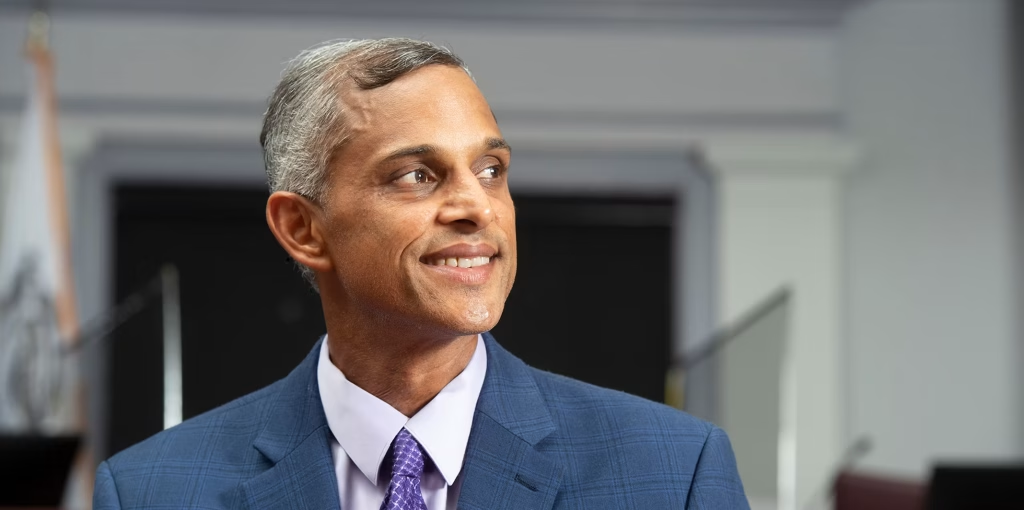
“I was the front man, I was the ambassador of Morrisville,” he said. “I worked with the county commissioners, I went to the school board meetings, I worked with [the North Carolina Department of Transportation] to get all of this done.”
As a county commissioner, Rao said he would continue to push for economic development opportunities, housing, and education funding, this time for all of Wake County.
“I don’t believe there’s time for on-the-job training for the commissioners,” he said. “So if I win … [then] on Day 1, I’ll be ready to lead. I already know who I’m gonna call. I’m not trying to brag, but I’ve got a lot of people in this phone, and that’s how I work.”
Big ideas
Bring Morrisville’s Language Access Plan to all of Wake County
In 2024, Morrisville approved a plan to provide free translation and interpretation services for its diverse, multilingual population. The first step was to translate important town messages and signage into Hindi, the most commonly spoken language in Morrisville after English. Eventually the town plans to offer more resources in Spanish, Vietnamese, and Chinese.
“Given how diverse the county is, that would be a perfect program,” Rao said. “You could replicate it in Cary, you could replicate it in Apex, you could replicate it in Holly Springs.”
Don’t allow new data center construction until we set rigorous standards
Data storage facilities are popping up all around the country to power artificial intelligence. They’re big and energy intensive and create few permanent jobs, galvanizing residents to oppose their construction. Wake County is no exception: a data center proposal in Apex has raised concerns about water and energy use, noise pollution, and rising utility bills.
“Let’s hold off on these massive data centers until we have a better standard set in place by the state, by the county, by Governor Stein’s AI Task Force,” Rao said. “What is the energy strategy? What kind of changes do [we] have to make in the [land use ordinance]? What are the requirements we’re going to impose on these data centers so that they’re using nuclear, they’re using solar, they’re using renewables?”
Rao said Wake County should take the lead on developing a data center strategy—as well as a broader AI strategy—that all the towns can follow.
Mona Singh
Mona Singh grew up in Delhi, India, where in 1984 she saw fellow Sikhs attacked and killed in a wave of mob violence that targeted the small religious minority, claiming thousands of lives. She immigrated to the U.S. for college in the late 1980s, and later became an American citizen.

“The first thing I did after I was naturalized was go and register to vote,” Singh said. “The viewpoint that I bring, from being an immigrant and seeing the world, [is that] people take things for granted because they haven’t seen how things can go wrong.”
Singh lives in Cary and works in technology; she has about 130 patents to her name from her contributions to smartphone technology and augmented reality. In her spare time, she volunteers with the Wake County Democratic Party (she is a former precinct chair), teaches English to refugees, and serves on the Town of Cary’s Information Services Advisory Board.
Big ideas
Use smart technology to improve county services and save money
In her professional life, Singh focuses on people-centric design for technology. A lot of her work involves observing how people—from doctors and nurses to car mechanics and J.Crew buyers—work, then designing systems to make that work easier and cheaper. She said Wake County can do the same thing.
“The biggest problem is understanding what the problem is. Once you know that, then you can find a solution,” she said. For Wake, Singh believes a big part of the problem is silos between different county services.
For example: “Why can’t you register to vote when you go to get health care?” she wondered aloud. “Why do you need to create a separate office? When you start observing things with that mindset, you can get a tremendous amount of savings. And it’s not just savings, it makes lives better.”
For Singh, smart technology is a tool for human connection. She imagines a future where Wake County has an Uber-like app to coordinate rideshares on public microtransit. She wants to collect more data on violations of the county’s nondiscrimination ordinance in order to identify patterns and root causes of discrimination. But she’s also cognizant of the risks tech can pose to privacy and people’s jobs.
“We need someone [on the commission] who really understands” artificial intelligence and smart technology, Singh said, “because otherwise we’re not going to have any benefits, and we’ll have all the problems.”
Find creative ways to tax Wake’s wealthiest residents
About 75% of Wake County’s budget comes from property taxes. Singh wants to find ways to generate more tax revenue without burdening low- and middle-income residents who have already seen their tax bills rise in recent years.
“Our hands are tied in a lot of ways,” she said. “The legislature doesn’t give us the ability to have progressive taxes. They’re getting rid of corporate taxes. Income taxes are coming down, and then we’re giving out [private school] vouchers. That’s the problem.”
In lieu of a progressive property tax, Singh proposes that the county impose an extra tax on certain features of only the biggest, most expensive homes. She wants to “work around our constraints but still generate more tax revenue without hurting people.”
“If you look at the $6 million homes, generally, they’ll have big outdoor kitchens or patios,” Singh explained. “Right now we only tax heated and cooled areas, but what else can we include?”
Marguerite Creel
Marguerite Creel runs a tutoring business in Raleigh and lives nearby in an unincorporated part of the county. Before moving to North Carolina 20 years ago, she worked in the Clark County, Nevada, district attorney’s office and the Clark County manager’s office. Creel has taught classes on local government and political science at the UNC School of Government, Peace College, and the University of Nevada, Las Vegas. She ran for NC House District 40 as a Democrat in 2022. According to state voting records, she consistently voted in Republican primaries from 2010 through 2018 and then switched to Democratic primaries in 2020.

Creel has a three-part platform: Take better care of Wake’s senior citizens, secure reliable and sustainable energy sources for the county, and improve Wake County public schools by offering more electives and more online and summer classes and spending less on noncitizens.
Big ideas
Stop charging seniors property taxes
Creel said Wake County’s senior residents should not have to pay property taxes on their primary homes. The county currently has a limited number of property tax relief options for low-income seniors with disabilities. Creel’s idea, which is much more expansive, would require approval from the General Assembly and could reduce the county’s annual revenue by hundreds of millions of dollars. Asked where she would cut costs or raise new revenue to fill that hole, Creel said the county should pursue more public and private grant opportunities. She said seniors would be inclined to donate money to their most-valued local programs in lieu of paying taxes.
Save money in Wake schools by spending less on immigrant students
Creel said she thinks the Wake County Public School System should spend less money on noncitizen students in order to slim down its budget. Asked why and how she would do this, Creel said “we are supplanting our kids with foreign students. … At some point it’s too much.”
It is unclear how WCPSS would be able to target funding cuts to immigrant students when the school district does not track students’ citizenship statuses. Creel said she does not support cutting funding to English as a Second Language instruction. She stressed she is “pro-immigrant” and “pro-culture.”
Kimberly McGhee
Kimberly McGhee is a small business owner and community advocate who lives in Southeast Raleigh. McGhee does not have experience in local government, which is kind of the point of her campaign: “I’m a learn-it-all leader, not a know-it-all politician,” she said.

McGhee said she wants to bring an activist’s perspective to county government: to spend more time in the community and demystify the commission’s work for residents who don’t understand or feel disconnected from it.
Big idea
Bring county government to the people through town hall-style events
McGhee would use town hall events to gather resident feedback and crowdsource priorities for the county’s annual budget.
“I am a person that will get out there in the community and listen to what you have to say, even if it’s not pleasant,” she said. “It’s so simple to bring people together to listen and say, ‘What does your town need? How do you feel like the commission office can come and support you all?’”
McGhee especially wants to bring young people and working people to the table who otherwise wouldn’t be engaged in the county’s work.
Robert Mitchener
Robert Mitchener is a former Wake County deputy sheriff and current State Capitol Police officer. He said 30 years in law enforcement across different jurisdictions and in the school and criminal justice systems have made him acutely aware of some of the most difficult issues Wake County residents contend with, like the rising cost of living and homelessness.

When it comes to addressing those issues, Mitchener doesn’t have firm goals. He has not held local office before. He said he wants to serve the county at large because “there’s not a street or highway that I have not been on, not a neighborhood that I have not been in,” from his time in the sheriff’s department.
Big idea
More mental health resources for first responders
Mitchener supports expanding mental health resources for all Wake County residents, but he noted the particular strain on first responders.
“They do a lot of things that the average person does not see or do, and sometimes they are in crisis situations,” Mitchener said. “Ask them, do they want to speak to someone to help them? We need to put something in place where the first responders can get that kind of one-on-one talk when they go through a crisis situation.”
Comment on this story at [email protected].
You must be logged in to post a comment.