

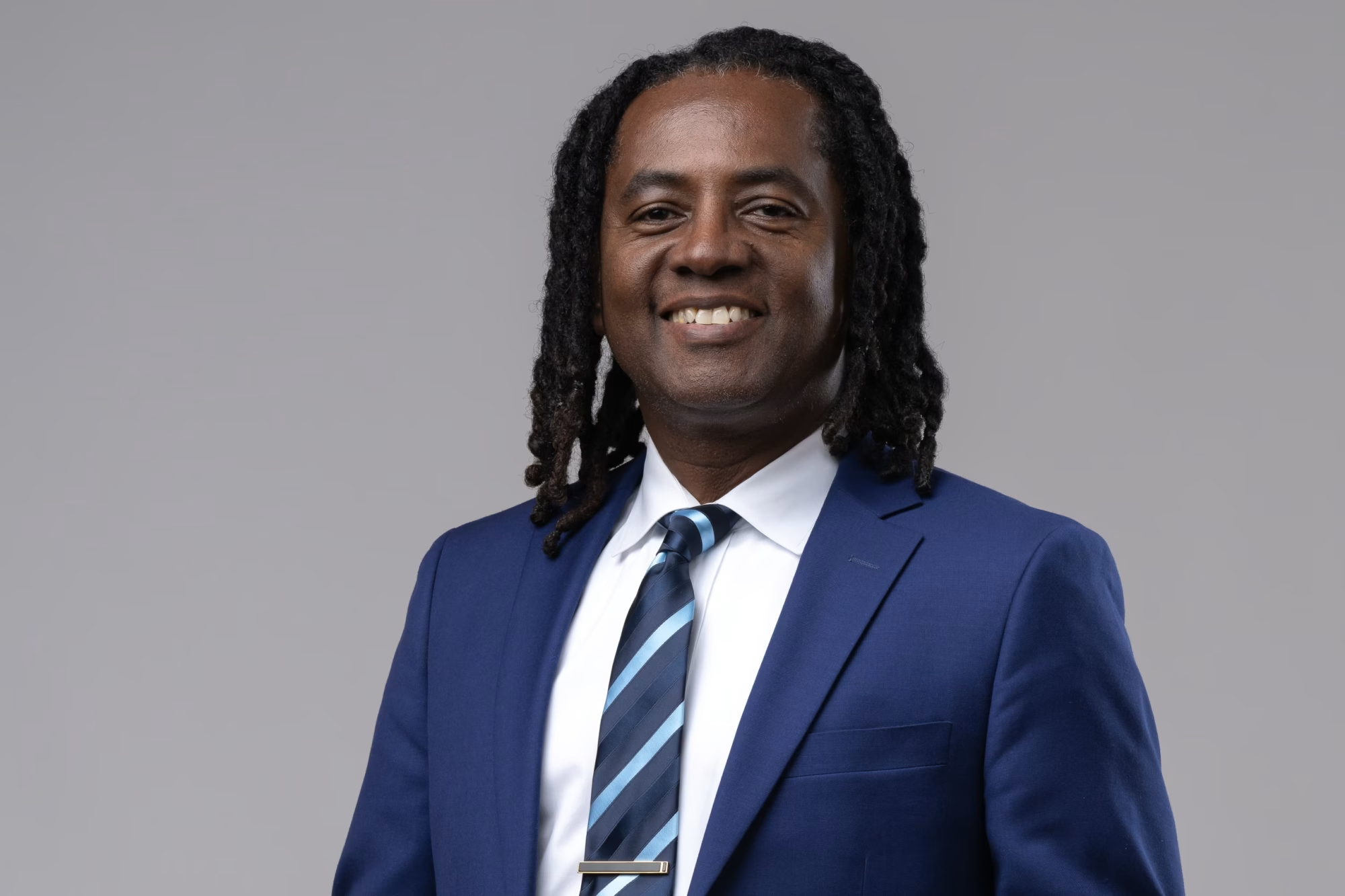
Name: Keith A. Bishop
Age: 62
Party affiliation: Democrat
Campaign website: ElectKeithBishop.com
Occupation and employer: Attorney
1. What in your record as a public official or private citizen demonstrates your ability to be effective, fair, and impartial on the bench? What do you believe qualifies you to serve as a district court judge? Please include your experience relevant to civil and criminal law.
A Member in Good Standing with the State Bar. I have 33 years of experience as an attorney who has practiced in the State and Federal in and out of the State.
2. How would you define your judicial philosophy? How do you define yourself politically? How does that impact your judicial approach?
My judicial philosophy is aligned with the philosophy of Living Constitutionalists. Constitutions are living documents that evolve to meet the changing needs of society. The provide a stable foundation for ideas of freedom to thrive.
Politically, I am a Democrat, like my mother and grandmother before me.
As a Democrat I place my faith, family, and community as the three main pillars of my judicial philosophy. Everyone must be secure in their faith, love their family, and be safe in their community. This sometimes mean that we must restrain government from the abuse of its power, be transparent as neutral, and accountable in managing our communities’ interest in security. I am always guided by the admonition: “feed my sheep.”
3. What do you believe are the three most important qualities a judge must have to be an effective jurist?
The qualities a Judge must possess are a) wisdom to perceive what is lawful and equitable, b) compassion, and c) Love for the community he serves. Of these three, Love for the community he serves is the most important quality.
4. The recently passed Iryna’s Law eliminates the option for judges to release people pretrial with only a written promise to appear in court and requires that they set secured bonds for defendants charged with violent offenses or with more than two prior convictions. Do you support these changes? Why or why not?
A) This is a challenging question because it temps the responder to discuss subjective variants of the issue of low, medium and high-risk considerations of pre-trial release. Judges, and candidates for election as judges, must address these issues frequently. Judges and judicial candidates should, therefore, refrain from commenting on these issues to maintain their transparency as independent neutrals.
B) Judges are tasked with employing various skillsets, principles of fairness, fidelity to the law, and commitment to our community to ensuring domestic tranquility. Judges must adhere to ecclesiastical principles of equity and legal principles of justice to resolve social disputes. Our community depends on our concept of both fairness and compassion addressing this issue. I will commit to following the laws in the context of these principles.
C) Society has traditionally adopted the belief that Pre-Trial Detention is appropriate. It is not challenged with vigor. Our challenge is that many arbitrary presumptions are embraced to justify this presumption and opposing views are suppressed to the hurt of our community. Judges are at the core of the dissatisfaction in pre-trial detention and release policies because they often deviate from their fidelity to neutrality, lose their independence, and rarely spend time making objective evaluations. In this they fail all consumers of judicial services.
D) If elected, I will rely on maintain my fidelity to the law, honor the principle of innocent until proven guilty, evaluate the evidence in support of pre-trial release versus pre-trial detention, and balance the community’s interest in safety versus the individual’s right to be unrestrained in his liberty interests.
E) Finally, I will not embrace Pre-Trial Detention policies as a means of pre-conviction punishment. I will collateral consequences of both Pre-Trial Detention and Pre-Trial Release policies. These issues are in tension, and they require impartial and independent evaluation to arrive at a judgment that promotes community safety and security.
5. Black North Carolinians are incarcerated at much higher rates than their white peers. What responsibility do judges have to address racial inequity in the court system?
Judges have a high level of responsibility to address racial inequity in the court system. I have observed judges imposing disparate sentences to individuals charged with the same offense in the same courtroom in the same criminal court session. Judges are often the gatekeepers. Often, they are indifferent to the plight of persons (both victims and offenders) coming before them. Judges must, firstly, embrace their unique roles as independent neutrals. Second, they must be faithful the law. Finally, they must communicate in a transparent and accountable their observations to the two legislative and executive branches of government the issues that may challenge their constitutional mandate to maintain domestic tranquility.
6. Do you support restorative justice practices and diversion programs? What kinds of cases do you believe should be exempted from diversion programs?
Yes. I support restorative justice practices and diversion programs.
I often do not like absolutes. Good candidates for exclusion from diversion programs may include mass killing. A sufficiently wide breadth of studies supports the concept of diversion programs and without a specific fact to address, I should avoid straying beyond the studies.
7. How should judges take immigration status into consideration, both in case resolutions and in courtroom proceedings?
Immigration status is often regulated by Federal and State laws, which require Judges to inform defendants in criminal cases that one consequence of certain criminal conviction may include their deportation. The equal protection laws require judges to regulate restraints on individuals’ rights and property on the basis of race or national origin. Judges should ensure that persons seeking justice are treated fairly and equally in both the courtroom proceedings and case resolutions through settlements.
8. In many cases, voters know very little about the judges they are electing. Tell us something about yourself that our readers may be surprised to learn.
I grew up in Brooklyn, NY. I came to North Carolina in 1988. I attended NCCU Law School from 1989 to 1992. I passed the bar exam in 1992. My started my first job as an associate attorney with CC “Buddy” Malone, a pillar of the African American legal community. I learned the meaning of resilience with Buddy Malone. I have represented clients in all courtrooms, and I have served as a Truancy Court Judge for more than 20 years. My law practice, which I established since 1997, as served as a training ground for many lawyers. I wave provided several hundred thousand dollars in fee legal services to clients.
I have 4 children (1 deceased) and 3 grandchildren. I am a long-time member of St. Titus Episcopal Church. I am a Shepard Society 1999-2000 Achievement Honoree.
I saw my brother killed in front of my sister’s home while visiting for his birthday and I watched my mother cleaned his blook off of the sidewalk. The offender was never identified. I saw my child injured and died a day later. I held to my family’s motto: FIRM IN FAITH. I saw my sister experience a belated cancer diagnosis and later died.
I worked every summer from age 15 until I graduated from college. I worked as a messenger, bank clerk, records manager at Glaxo, and substitute teacher in the Durham Public Schools while attending law school. I worked as a social worker. I have tried major civil and criminal trials and represent client from all walks of life in and out of the State of North Carolina.
9. Identify and explain one principled stand you would be willing to take if elected that you suspect might cost you some points with voters.
District Court interacts most frequently with misdemeanors and family court issues. I will take a “Yard Stick” to Court and promise to treat everyone with the same Yard Stick of respect and dignity, as I would want to be treated.
10. Are there any issues this questionnaire has not addressed that you would like to address?
I believe that a Judge must have a breadth of knowledge and experience to inform his or her judgment. He must treat all persons with dignity, be patient, and be humble. He must walk in love.